
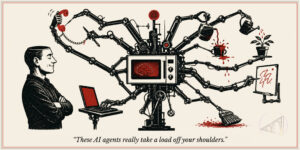
Knowledge workers can’t focus anymore because AI agents create constant interrupts, force high verification load, and impose a new attention tax that exceeds limited human attention and working-memory capacity, producing AI brain fry.
Key Takeaways
- Human attention was already fragmented (average ~47-second screen focus; 23–25 minutes to resume after interruption); AI agents multiply this cost through parallel threads.[1][2]
- A BCG/HBR study of 1,488 workers found 14% experience AI brain fry from excessive AI oversight, with 33% more decision fatigue and 39% more major errors.[3]
- Verification load—the cognitive cost of checking AI coding-assistant output—partially mediates rising fatigue even when task time drops.[4]
- Productivity gains from agents peak at 2–3 simultaneous tools and decline beyond that as context-switching and oversight dominate.[3]
- Practical reductions include capping agents at three or fewer, using load architecture (McKinsey), time-boxed assist blocks, and just-in-time context engineering.
The Human Attention Bottleneck: Why AI Agents Are Making Focus Harder
AI agents make sustained focus harder because they parallelize execution while human attention remains serial and limited.
Gloria Mark’s observational research showed knowledge workers spend only about 3 minutes on a single event before switching or being interrupted; interrupted work takes roughly 23–25 minutes to resume on the same day, often after intervening tasks.[1] More recent tracking found average screen attention collapsed from ~2.5 minutes in 2004 to roughly 47 seconds, with half of screen periods lasting 40 seconds or less and hundreds of switches per day.[2]
Industry analyses describe the shift clearly: AI agents run in parallel while humans must oversee, judge, and integrate multiple threads, relocating the bottleneck from typing speed to limited human attention.[5] Working memory holds only about 3–5 chunks at once, and Cognitive Load Theory shows excess load (especially extraneous load from interruptions) impairs performance.[6] Practitioners on Reddit observe that coding agents encourage a “prompt, skim, accept, repeat” loop that erodes the ability to hold large system context—the remaining human edge.[7]
AI Brain Fry and the New Attention Tax of Parallel Agents
Parallel AI agents impose a measurable attention tax that produces AI brain fry—mental fatigue from oversight beyond cognitive capacity.
A Boston Consulting Group study published in Harvard Business Review surveyed 1,488 U.S. workers and found 14% experienced AI brain fry, with symptoms including mental fog, difficulty focusing, slower decision-making, and headaches.[3] High-oversight roles reported 14% more mental effort, 12% more fatigue, and 19% greater information overload. Those with AI brain fry showed 33% more decision fatigue, 39% more major errors, and higher intent to quit (rising toward 34%). Prevalence reached 26% in marketing and was elevated in engineering, operations, and IT.[3]
Productivity gains peak around two to three simultaneous agents or tools and then decline; workers using four or more report net reductions in perceived productivity as context-switching and oversight costs dominate.[8] An arXiv paper formalizes “attention tax” and “handoff tax” in multi-agent systems, modeling how decomposition reduces some costs but incurs handoff costs that depend on task depth and verification needs.[9] Reddit discussions frequently describe fragmented attention from agent swarms and the paradox that greater capability produces more half-finished work and less shipping.[10]
Verification Load: The Hidden Cognitive Cost of Checking AI Coding Assistants
Verification load is the hidden cognitive cost of checking AI output and partially drives fatigue even when overall task metrics improve.
A 2026 CHI paper introduced a mode-agnostic verification-load index (failures, time-to-first-compile, code churn, pauses, and context switches) and found it partially mediates rising stress and fatigue.[4] In the study (N=60), AI reduced workload by 18.2 TLX points and time by 22% while improving correctness, yet verification behaviors still drove fatigue; interface mode modulated the load.[4]
Harvard researchers analyzing Jellyfish data across hundreds of firms found AI coding agents increase lines of code (~30%), commits, and pull requests, but human code review remains the dominant bottleneck; AI agents handle only a minority of review comments, limiting net software-output gains.[11] Microsoft Research frameworks emphasize “verification engineering”: AI produces code faster than humans can inspect it, so proving correctness via tests, separate reviewers, and runtime checks becomes the hard part.[12] Anthropic’s AI fluency leadership has described a “discernment tax”—the effort of evaluating AI output that can exceed the cost of doing the task oneself for skilled work.[13]
Cognitive Load When Managing AI Agents: How Knowledge Workers Get Interrupted
Managing AI agents raises extraneous cognitive load through model-initiated interrupts, context switching, and coordination demands that knowledge workers must absorb serially.
Research applying Cognitive Load Theory to AI-assisted work shows extraneous load (from ambiguous prompts, context switching, and model-initiated interruptions) has a larger negative effect on performance than intrinsic load; model-initiated task switching is a strong predictor of decline.[14] A related framework decomposes agent task complexity into intrinsic load (solution-path structure) and extraneous load (presentation ambiguity), revealing performance cliffs as load increases.[15]
McKinsey notes that AI can automate a large share of hours but increases cognitive intensity per remaining hour; without deliberate load architecture, workers face denser judgment and oversight demands.[16] Reviews of human-AI symbiosis highlight that both humans (working memory ~3–5 chunks) and AI systems (context windows) fail under overload, yet current workflows often push full coordination onto the human.[17] Practitioner accounts describe agent notifications, status checks, and handoffs as continuous micro-interruptions that prevent re-entry into deep work, with the human acting as a serial bottleneck for parallel agent execution.[5]
Reducing the Attention Tax: Practical Ways to Protect Focus in the Agent Era
The attention tax can be reduced by capping agent load, designing intentional load architecture, and applying context-engineering practices that limit verification and interrupts.
BCG findings indicate that using AI to replace routine tasks reduces traditional burnout while high-oversight patterns increase brain fry; capping simultaneous agents at three or fewer and designing for lower oversight demand protect cognitive resources.[3][8] McKinsey recommends load architecture: interspersing cognitively intense work with lighter tasks, batching notifications, designating single-person triage for AI output, and protecting deep-work blocks so AI handles noise while humans retain high-value judgment.[16]
Practical individual tactics include time-boxing AI interaction into short assist blocks, implementing prompt gates (clear outcome, quality ceiling, stop rules), running attention audits, and using specialized sub-agents to shrink individual context and verification scope.[18] Context-engineering practices such as just-in-time retrieval, compaction of long histories, and sub-agent delegation reduce attention and handoff taxes by avoiding full context preload.[19] Shared team norms around agent use, clear ownership of verification, and explicit “stop doing” lists further lower fatigue; treating verification as a deliberate, limited activity rather than constant monitoring is protective.[8]
Conclusion
The core problem is not that AI agents lack capability; it is that they transfer an attention tax, verification load, and interrupt burden onto limited human cognition, producing AI brain fry and eroded focus. The solution is deliberate load architecture rather than unrestricted agent use.
Start with these steps:
- Cap active agents or tools at three or fewer and track perceived productivity and fatigue.
- Time-box AI interaction into short assist blocks with explicit stop rules.
- Batch notifications and protect at least one deep-work block daily.
- Designate clear ownership for verification and use just-in-time context instead of preloading everything.
- Prefer AI for routine replacement over high-oversight judgment tasks where possible.
These changes restore usable attention windows, reduce extraneous cognitive load, and convert agent capability into sustainable output rather than fragmented exhaustion.
Read our ultimate guide to the Neuroscience-Based Deep Work System for Knowledge Workers.
References
- Mark, G., Gonzalez, V. M., & Harris, J. (2005). No task left behind? Examining the nature of fragmented work. Proceedings of the SIGCHI Conference on Human Factors in Computing Systems. https://ics.uci.edu/~gmark/CHI2005.pdf
- Mark, G. (2023). Attention Span: A Groundbreaking Way to Restore Balance, Happiness and Productivity. Hanover Square Press. https://sobrief.com/books/attention-span
- Bedard, J., Kropp, M., Hsu, M., Karaman, O., Hawes, J., & Kellerman, G. (2026, March 5). When using AI leads to “brain fry.” Harvard Business Review. https://hbr.org/2026/03/when-using-ai-leads-to-brain-fry
- Fan, G., Liu, D., Pan, L., & Zhang, R. (2026). When help hurts: Verification load and fatigue with AI coding assistants. Proceedings of the 2026 CHI Conference on Human Factors in Computing Systems. https://dl.acm.org/doi/10.1145/3772318.3791176
- Maymin, P. (2026, February 21). The end of deep work: Why agentic AI rewards context-switchers. Forbes. https://www.forbes.com/sites/philipmaymin/2026/02/21/the-end-of-deep-work-why-agentic-ai-rewards-context-switchers/
- Sweller, J. (1988). Cognitive load during problem solving: Effects on learning. Cognitive Science, 12(2), 257–285; Cowan, N. (2010). The magical mystery four. Current Directions in Psychological Science, 19(1), 51–57. https://en.wikipedia.org/wiki/Cognitive_load
- Informal_Tangerine51. (2026, March 11). Coding agents are quietly frying people’s attention spans [Online forum post]. Reddit. https://www.reddit.com/r/AgentsOfAI/comments/1rqy6ty/coding_agents_are_quietly_frying_peoples/
- Coverage of BCG findings on agent limits and protective factors. The Algorithmic Bridge. https://www.thealgorithmicbridge.com/p/how-to-stop-ai-agents-from-frying
- Anchan, A., & Sen, N. (2026). Attention tax, handoff tax: A stylised model of when multi-agent LLM systems help. arXiv:2610.06069. https://arxiv.org/abs/2610.06069
- Various authors. (2026). Discussions of AI brain fry [Online forum posts]. Reddit. https://www.reddit.com/r/technology/comments/1rsoqcy/ai_is_exhausting_workers_so_much_researchers_have/
- Chen, F., & Stratton, J. (2026). Analysis of AI coding agent impact on software output (via Jellyfish data). Reported in Ars Technica. https://arstechnica.com/ai/2026/10/ai-coding-agents-generate-more-code-but-not-more-software/
- Lavaee, A. (2026). Verification engineering principles for coding agents (via Microsoft Research discussion). https://www.theneuron.ai/explainer-articles/ai-coding-agents-verification-engineering-alex-lavaee/
- Swanson, K. (2026). Remarks on the discernment tax of AI use. Business Insider interview. https://www.businessinsider.com/anthropic-ai-fluency-chief-discernment-tax-work-2026-9
- Lepine, B., Kim, J., Mishkin, P., & Beane, M. (2025/2026). Precision proactivity: Measuring cognitive load in real-world AI-assisted work. arXiv:2505.10742. https://arxiv.org/abs/2505.10742
- Wang, Q., et al. (2026). Beyond accuracy: A cognitive load framework for mapping the capability boundaries of tool-use agents. arXiv:2601.20412. https://arxiv.org/abs/2601.20412
- McKinsey & Company. (2026). Five principles for designing brain-powered organizations. https://www.mckinsey.com/capabilities/people-and-organization/our-insights/the-organization-blog/five-principles-for-designing-brain-powered-organizations
- Authors. (2026). Overloaded minds and machines: A cognitive load framework for human-AI symbiosis. Artificial Intelligence Review. https://link.springer.com/article/10.1007/s10462-026-11510-z
- Practitioner sources on AI load management (2026). https://www.techwellbeing.co.uk/digital-detox-ai-overload-focus-wellbeing/ and https://spiralscout.com/blog/ai-agent-cognitive-load-sub-agents
- Stellar Work. (2026). Your agent isn’t getting dumber. You’re overfeeding it. https://www.stellarwork.com/captains-log/your-agent-isnt-getting-dumber-youre-overfeeding-it