
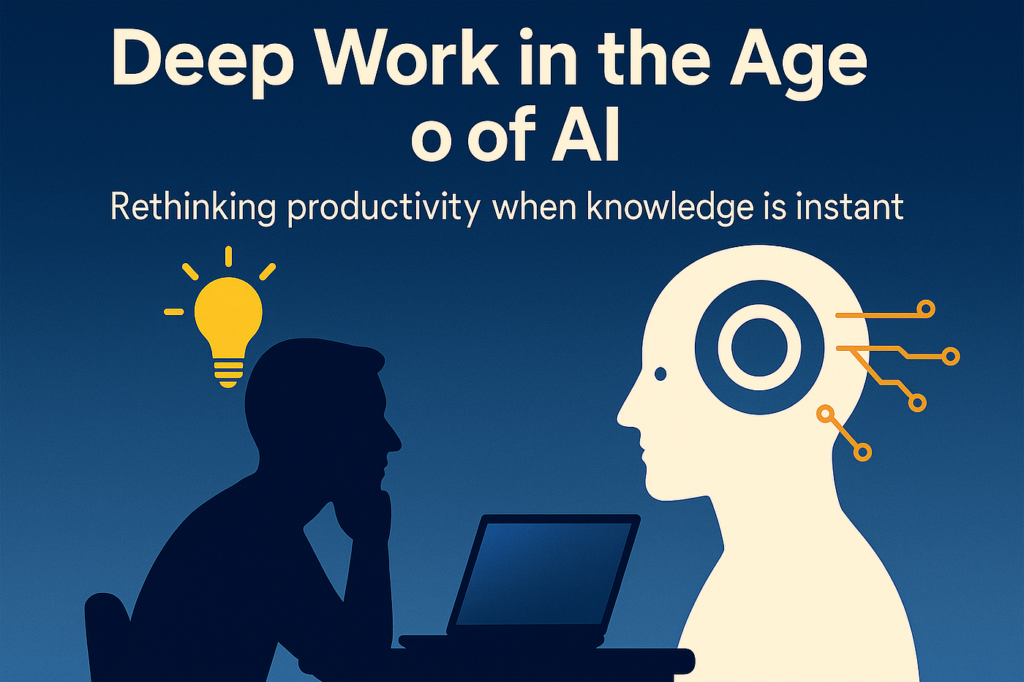
Neuroscience-Based Deep Work System for Knowledge Workers: Build Unbreakable Focus in the AI Era
Table of Contents
- Why Traditional Deep Work Advice Fails Knowledge Workers Today
- The Neuroscience of Focus: What Actually Controls Deep Work
- Cognitive Load Mapping: Diagnose Your Current Focus Capacity
- Designing Your Core Deep Work System (The 4-Pillar Architecture)
- Attention Residue and Context Switching: Engineering Zero-Cost Transitions
- How to Trigger Flow State in Under 15 Minutes Using Neuroscience Protocols
- Ultradian Rhythm Scheduling: Aligning Deep Work with Your Brain’s Natural Cycles
- Environment and Cue Design for Sustained Focus (Beyond the Obvious)
- Integrating AI Tools Without Destroying Deep Work Capacity
- Measuring and Tracking Your Deep Work Output (Metrics That Matter)
- Advanced Protocols: Building Cognitive Reserve and Focus Stamina
- Common Failure Modes and How High Performers Recover Focus Fast
- Scaling Your System: From Individual Deep Work to Team and Project Level
- The 90-Day Implementation Plan for a Neuroscience-Based Focus System
You sit down to solve a difficult problem — refactoring a fragile codebase, modeling financial risk, analyzing operational data — and less than a minute later, your attention is somewhere else entirely. A Slack notification appears. An email tab flashes. You remember an unanswered message. Then an AI prompt pulls you into another loop of shallow interaction. By the time you return to the original task, the mental thread is gone. This has become the defining challenge of modern knowledge work. In the AI era, your competitive advantage is no longer access to information. Everyone has that now. The real advantage is the ability to sustain deep, uninterrupted thinking long enough to produce high-quality insight, strategy, engineering, analysis, and creative problem-solving. Unfortunately, most deep work advice was designed for a different world. “Turn off notifications.” “Time block your calendar.” “Wake up earlier.” Those tactics help, but they fail to address the biological, neurological, and environmental realities knowledge workers now face every day. This neuroscience-based deep work system takes a different approach. Instead of relying on motivation or rigid discipline, it helps you design a focus architecture that works with your brain rather than against it. Whether you are a software engineer, analyst, consultant, accountant, researcher, or technical operator, the goal is the same: protect your cognitive bandwidth and make deep focus sustainable again.
Why Traditional Deep Work Advice Fails Knowledge Workers Today
Traditional productivity advice often assumes you can simply decide to focus and then maintain concentration through willpower alone. That model no longer reflects modern work conditions. The average knowledge worker achieves only about 2–3 hours of genuine deep focus per day, while only around 39% of tracked work time occurs in a state of true concentration. At the same time, more than 60% of working hours are consumed by coordination, meetings, updates, and what many researchers now call “work about work.” The problem is not laziness. It is environmental overload. Roughly 80% of knowledge workers keep their inbox or communication tools open throughout the day, and three out of four report constant pressure to multitask. Add AI-assisted workflows, fragmented collaboration tools, and nonstop context switching, and the brain rarely receives uninterrupted cognitive runway. Even elite performers typically sustain only around four hours of intense deep work daily. That matters because the brain is not designed for continuous high-intensity cognition over eight or ten consecutive hours. Yet many professionals still judge themselves by industrial-era productivity expectations rather than biological reality. A modern deep work system for knowledge workers has to acknowledge three truths simultaneously:
- your attention is biologically limited
- your environment is actively competing for it
- AI tools can either amplify focus or destroy it
The goal is not endless concentration. The goal is strategically protected concentration.
Regarding the goal of achieving “strategically protected concentration”, in the age of Agentic AI, the need for protected concentration is even more pronounced as AI agents create constant interrupts. Please read our post on “Why You Can’t Focus Anymore: The Attention Tax, AI Brain Fry, and Verification Load of Managing AI Agents” for Neuroscience-based strategies for protecting deep work.
The Neuroscience of Focus: What Actually Controls Deep Work
Deep work is not just a productivity concept. It is a measurable neurological state. When you enter sustained focus, your prefrontal cortex takes control of executive function, working memory, prioritization, and decision-making. At the same time, the brain suppresses activity in the default mode network — the system associated with mind-wandering and internally drifting attention. This process is metabolically expensive. Focused cognition consumes large amounts of glucose and oxygen while requiring multiple attentional systems to coordinate simultaneously across roughly 14 interconnected brain regions. That explains why deep thinking feels mentally heavy even when you are sitting still. It also explains why concentration improves with repetition. Repeated periods of intense focus strengthen neural pathways through processes like myelination and increased BDNF production. Over time, the brain becomes more efficient at entering and sustaining cognitively demanding states. In practical terms, deep work behaves like a trainable neurological skill. The limitation most professionals underestimate is working memory. Research consistently shows that working memory can actively hold only about 3–5 meaningful chunks of information for roughly 20 seconds without reinforcement. That bottleneck is one reason distractions are so destructive. A single interruption can collapse an entire cognitive structure your brain was actively maintaining. Once you understand that, productivity stops being a motivation problem and becomes a systems engineering problem.
Cognitive Load Mapping: Diagnose Your Current Focus Capacity
Before you optimize focus, you need visibility into how your cognitive resources are actually being consumed. Most knowledge workers dramatically underestimate their fragmentation. Research suggests the average professional switches applications roughly 1,200 times per day and spends nearly four hours per week simply navigating between tools, tabs, dashboards, and communication systems. That constant fragmentation increases:
- mental load
- temporal pressure
- frustration
- decision fatigue
Cognitive load generally falls into three categories:
- Intrinsic load — the inherent complexity of the task
- Extraneous load — distractions, inefficient systems, unnecessary friction
- Germane load — the mental effort involved in learning and integrating knowledge
High-performing professionals usually tolerate high intrinsic load well. The real damage comes from uncontrolled extraneous load. Remote and hybrid workers often report stronger cognitive peaks because they can control their environment more effectively. At the same time, burnout rates in these environments remain remarkably high — often between 34% and 82% depending on the industry and workload. Why? Because flexibility without boundaries often creates permanent low-grade cognitive activation. A personalized cognitive load mapping system works far better than generic productivity advice because it reveals where your mental bandwidth is actually leaking.
Quick Diagnostic Exercise
Track a single workday and document:
- every app switch
- every interruption
- every energy dip
- every communication check
- every moment you lose task momentum
Then estimate your true percentage of uninterrupted deep focus. Most professionals discover the number is far lower than they expected.
Designing Your Core Deep Work System (The 4-Pillar Architecture)
An effective neuroscience-based focus system is not built around hacks. It is built around architecture. The strongest systems rely on four interconnected pillars:
- Attention network management
- Ultradian rhythm alignment
- Cognitive load control
- Structured recovery
Together, these create a sustainable framework for high-level cognitive performance. This goes beyond traditional deep work philosophy because it accounts for measurable neurological and biological constraints. Top performers rarely force eight-hour focus marathons. Instead, they protect roughly 3–4.5 hours of genuinely high-quality cognitive output each day. That distinction matters. There is a major difference between:
- being mentally present for work
- and operating at full cognitive depth
The best deep work systems also create conditions for flow by combining:
- clear goals
- immediate feedback
- challenge-skill balance
- reduced interruption frequency
Without these elements, focus becomes unstable and mentally expensive. With them, deep work becomes easier to enter repeatedly.
Attention Residue and Context Switching: Engineering Zero-Cost Transitions
One of the most damaging forces in modern knowledge work is attention residue. Research from Sophie Leroy demonstrated that when you switch tasks, part of your attention remains attached to the previous task. Your brain may appear to have moved on, but cognitively, it has not fully disengaged. That residue lowers performance on the next activity and slows recovery into deep focus. Even short interruptions can create recovery periods lasting up to 23 minutes and 15 seconds. The modern workplace amplifies this problem dramatically. Most knowledge workers spend only about 3 minutes and 5 seconds on a task before switching to something else. Task-switching — not true multitasking — reduces efficiency by as much as 40% while increasing error rates. Unfinished tasks worsen the issue through the Zeigarnik effect, which keeps incomplete work psychologically active inside working memory. The result is constant cognitive bleed.
Practical Protocol: The “Task Parking” Method
Before switching tasks, spend 30–60 seconds documenting:
- the exact next step
- unresolved variables
- current assumptions
- where you should restart later
This simple habit dramatically reduces attention residue because the brain no longer needs to keep the unfinished task actively rehearsed in working memory. Think of it as creating a clean cognitive checkpoint.
How to Trigger Flow State in Under 15 Minutes Using Neuroscience Protocols
Flow is not mystical. It is neurological. Most research suggests the brain requires approximately 15–25 minutes of uninterrupted focus before the neurochemical shifts associated with flow begin emerging consistently. Dopamine and norepinephrine levels rise, attention narrows, and self-referential mental chatter decreases. For many professionals, the first signs of genuine flow appear between minutes 15 and 30. The challenge is surviving the entry phase long enough to get there. Flow becomes more accessible when three conditions exist simultaneously:
- clear goals
- immediate feedback
- a balance between difficulty and skill level
These conditions anchor attention in the present moment while reducing activity in the medial prefrontal cortex associated with excessive self-monitoring. One surprisingly effective strategy is pre-task priming. Writing tomorrow’s first deep work objective the night before leverages the Zeigarnik effect subconsciously. Your brain continues organizing the problem in the background, making re-entry faster the next day.
The 15-Minute Flow Protocol
- Define one specific and challenging outcome
- Remove every possible distraction
- Spend five minutes warming up on low-resistance portions of the task
- Commit to a full 90-minute session without negotiation
The hardest part of deep work is rarely the middle. It is protecting the first 15 minutes.
Ultradian Rhythm Scheduling: Aligning Deep Work with Your Brain’s Natural Cycles
Your brain does not operate at a constant cognitive intensity throughout the day. Human attention naturally rises and falls in roughly 90-minute ultradian cycles composed of:
- high-alert focus periods
- lower-energy recovery phases
Most people sustain only three or four genuine deep-focus windows daily. Trying to override those cycles with caffeine, meetings, or nonstop screen exposure usually backfires. As neurotransmitters like dopamine and acetylcholine deplete, mental clarity declines and cognitive friction increases. That is why high performers rarely rely on brute force concentration. Instead, they structure work around biological timing. Research suggests aligning demanding tasks with natural high-energy windows — often late morning for many professionals — can improve productivity by as much as 40% while reducing fatigue accumulation. The most effective structure typically looks like:
- 75–90 minutes of intense focus
- followed by 15–20 minutes of deliberate recovery
Recovery matters because cognitive restoration is part of the performance cycle, not a break from it.
Practical Implementation
Track your energy, clarity, and focus levels for one week. Identify:
- your strongest cognitive windows
- your recurring fatigue periods
- when analytical thinking feels easiest
- when shallow tasks feel more tolerable
Then place your most cognitively demanding work inside those peak neurological windows. Do not waste your sharpest brain state on email triage.
Environment and Cue Design for Sustained Focus (Beyond the Obvious)
Environment shapes cognition more than most professionals realize. Your brain continuously associates physical cues with behavioral states. Consistent focus environments reduce the activation energy required to enter deep work because the brain begins linking those cues with concentration automatically. This is why ritual matters. Research shows that 79% of workers cannot go a single hour without distraction, while average screen attention spans have dropped to roughly 47 seconds. Under those conditions, small environmental variables become disproportionately important. High performers often engineer highly repeatable focus conditions:
- identical playlists
- consistent lighting
- stable desk layouts
- fixed work rituals
- predictable session timing
These cues help shift the brain toward prefrontal engagement while suppressing default-mode wandering.
Actionable Cue Design
Create a repeatable pre-focus environment using:
- a dedicated deep work playlist or white noise
- stable monitor and keyboard positioning
- intentional lighting conditions
- a short breathing or reset ritual
- a verbal or written task statement before beginning
The goal is not aesthetic productivity. The goal is neurological consistency.
Integrating AI Tools Without Destroying Deep Work Capacity
AI tools are now embedded into nearly every layer of knowledge work. Roughly 75% of professionals use AI systems daily, but many report an unexpected side effect: more shallow interaction loops and less uninterrupted thinking. AI excels at:
- summarization
- retrieval
- formatting
- ideation support
- repetitive cognitive tasks
But there is a hidden tradeoff. Without boundaries, AI can fragment attention by encouraging constant prompt switching, rapid context hopping, and low-friction task sampling. Over time, this can weaken sustained problem-solving endurance. The strongest AI-assisted professionals use AI selectively rather than continuously. They protect core deep work blocks for:
- original reasoning
- architecture decisions
- strategic thinking
- synthesis
- difficult problem-solving
Then they batch AI interaction into designated shallow-work periods.
AI Guardrail Strategy
Use AI for:
- preparation
- research acceleration
- refinement
- summarization
- repetitive workflow support
But avoid turning AI into a permanent cognitive substitute during your highest-value thinking sessions. Deep work is still where competitive insight is created.
Measuring and Tracking Your Deep Work Output (Metrics That Matter)
Most productivity metrics are misleading because they measure visible activity instead of cognitive quality. Hours logged do not equal meaningful output. A more accurate system measures:
- uninterrupted deep work hours
- focus stability
- recovery efficiency
- output depth
- interruption frequency
Biologically, most professionals top out around 2–4 peak deep work hours daily. That limitation is normal, not a failure. Useful metrics include:
- uninterrupted focus percentage
- recovery time after interruption
- meaningful output completed
- number of context switches
- deep work consistency across weeks
Tracking often reveals surprising losses. Some professionals lose more than:
- 103 hours annually to unnecessary meetings
- 127 hours to focus recovery after interruptions
Once those costs become visible, optimization becomes much easier.
A Better Tracking Approach
Choose 3–5 meaningful metrics and review them weekly. Then adjust:
- scheduling
- environment
- AI usage
- meeting load
- task sequencing
Treat your focus system like a performance system, not a motivational experiment.
Advanced Protocols: Building Cognitive Reserve and Focus Stamina
Deep work capacity can expand over time. Repeated periods of sustained concentration strengthen neural efficiency through myelination and increased BDNF production. Eventually, difficult cognitive work consumes fewer mental resources than it once did. This creates what many researchers describe as cognitive reserve. Professionals with stronger cognitive reserve recover faster from mental strain, tolerate higher analytical complexity, and maintain decision quality under pressure more effectively. Building this reserve requires progressive overload — similar to physical training. You gradually increase:
- focus duration
- cognitive complexity
- recovery quality
- resistance to distraction
The highest-performing knowledge workers combine:
- ultradian scheduling
- deliberate practice
- structured recovery
- progressive focus training
Over time, their sustainable deep work ceiling increases without equivalent burnout escalation. That is the difference between temporary productivity spikes and long-term cognitive durability.
Common Failure Modes and How High Performers Recover Focus Fast
Most deep work systems fail for predictable reasons. The most common include:
- ignoring attention residue
- pushing through ultradian fatigue
- uncontrolled AI-driven shallow work
- excessive meeting fragmentation
- poor environmental cue design
When these systems collapse, recovery becomes increasingly expensive. A single interruption can trigger more than 23 minutes of cognitive recovery cost. High performers rarely rely on motivation to recover focus. They use rapid reset protocols instead. These often include:
- short walks
- physiological sighs
- brief visual defocus
- hydration
- sunlight exposure
- tactical disengagement from screens
The purpose is not relaxation. It is neurological recalibration. One of the biggest mistakes professionals make is attempting to force concentration through exhaustion. That approach usually depletes prefrontal resources further and lowers thinking quality. Elite performers protect recovery because recovery preserves cognitive precision.
Scaling Your System: From Individual Deep Work to Team and Project Level
Individual focus systems eventually collide with organizational reality. Even strong personal systems can fail inside interruption-heavy environments filled with reactive communication patterns and constant coordination overhead. Since coordination consumes more than 60% of many knowledge workers’ schedules, scaling deep work requires team-level alignment. The best-performing teams often implement:
- shared deep work windows
- communication boundaries
- reduced meeting density
- asynchronous collaboration
- AI-assisted shallow task handling
This reduces collective context switching while increasing uninterrupted cognitive output across the organization. At the project level, flow depends heavily on:
- clear objectives
- visible progress
- fast feedback loops
- minimized ambiguity
Without those structures, teams generate constant cognitive fragmentation. Deep work scales best when organizations treat attention as a finite strategic resource rather than an endlessly available commodity.
The 90-Day Implementation Plan for a Neuroscience-Based Focus System
Most professionals fail because they attempt to redesign everything simultaneously. The brain adapts more effectively through staged implementation. Habit formation for deep work systems generally requires roughly 30 days of repeated behavioral reinforcement before neurological patterns begin stabilizing consistently. A phased rollout works far better than an all-or-nothing productivity overhaul.
Days 1–30: Diagnosis and Core Architecture
Focus on:
- cognitive load mapping
- identifying interruption patterns
- designing your environment
- tracking deep work metrics
- reducing unnecessary context switching
The objective is visibility and stabilization.
Days 31–60: Flow Triggers and Ultradian Scheduling
Introduce:
- structured 90-minute focus blocks
- flow-entry protocols
- AI usage guardrails
- recovery rituals
- task parking systems
This phase builds consistency.
Days 61–90: Optimization and Scaling
Now refine:
- advanced recovery systems
- focus endurance
- cognitive reserve training
- team coordination structures
- long-term measurement systems
By this stage, deep work begins feeling less forced and more automatic. The goal is not perfection. The goal is building a repeatable neurological environment where deep thinking becomes easier to sustain.
Conclusion: Your Unbreakable Focus Starts Now
A neuroscience-based deep work system changes the way you operate as a knowledge worker because it shifts the focus away from hustle and toward cognitive quality. Your brain already has limits. The professionals who thrive in the AI era will not be the ones who work endlessly. They will be the ones who protect their finite attention with precision. That is the real advantage now. Not information. Not busyness. Not constant responsiveness. Deep thinking. Start small. Choose one part of this system — cognitive load mapping, ultradian scheduling, AI guardrails, or attention residue reduction — and implement it this week. Measure what changes. Refine what works. Remove what drains your attention unnecessarily. Over time, you are not just improving productivity. You are rebuilding your ability to think clearly in an environment designed to fracture attention. And in a world increasingly optimized for distraction, that ability becomes extraordinarily valuable.