
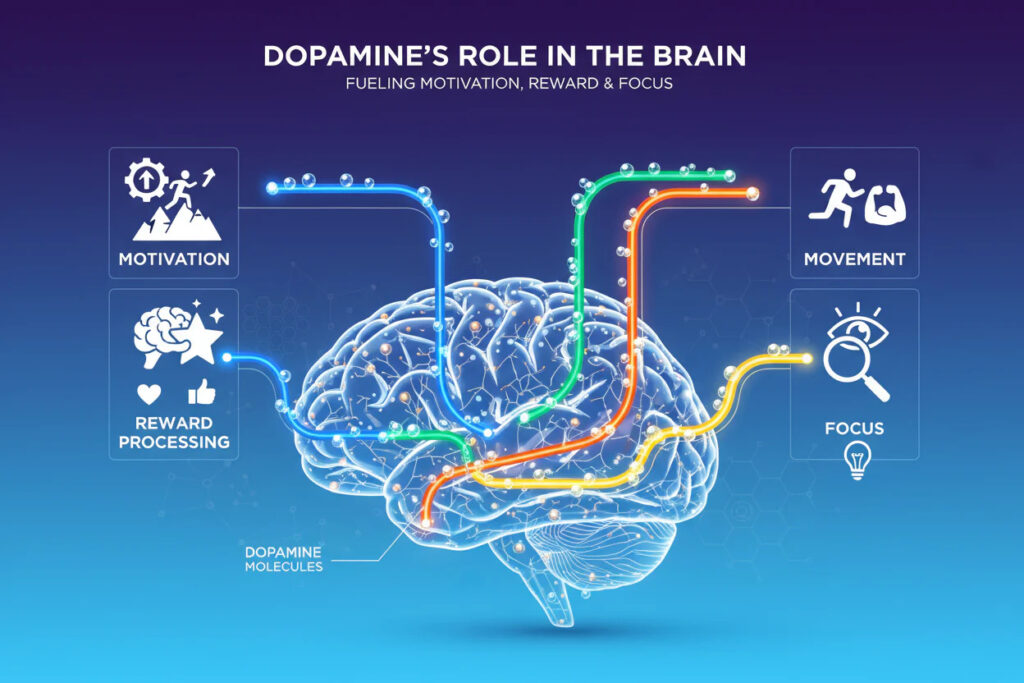
Neuroscience-Based Dopamine and Motivation Systems for Knowledge Workers: Sustain Focus, Drive, and Output in the AI Era
You’re three hours into a difficult systems refactor. The architecture makes sense. The requirements are clear. You even know the next step.
Yet somehow, you’ve checked Slack five times, skimmed email twice, and opened YouTube “for a minute” before snapping back to the task at hand.
The problem usually isn’t laziness. And for most high-performing knowledge workers, it isn’t a lack of ambition either.
More often, it’s a dopamine system trying to operate inside an environment it was never designed for: constant notifications, instant AI-generated answers, infinite novelty, and nonstop cognitive stimulation.
Modern work doesn’t just demand attention. It competes aggressively for it.
This article breaks down how dopamine actually influences motivation, focus, persistence, and cognitive effort — and how knowledge workers can build sustainable dopamine systems that improve output without relying on hustle culture or brute-force willpower.
Table of Content
- How Your Dopamine System Really Works in Modern Knowledge Work
- Why Traditional Motivation Advice Fails High-IQ Professionals
- The Dopamine Loops Destroying Your Focus and Output
- Dopamine Baseline vs. Peaks: Why Balance Beats Hustle Culture
- Neuroscience-Backed Ways to Reset Your Dopamine Sensitivity
- Building a Dopamine-Aware Daily Operating System
- Task Design That Triggers Healthy Dopamine Release
- Strategic Dopamine Detox Protocols for Knowledge Workers
- Using AI Without Hijacking Your Reward Circuitry
- Motivation Systems That Don’t Rely on Willpower
- Advanced Techniques: Variable Rewards, Effort-Reward Matching, and Identity-Based Motivation
- Measuring and Tracking Your Personal Dopamine Response
- Integrating Dopamine Systems with Deep Work and Execution Frameworks
- Long-Term Dopamine Architecture: Preventing Burnout While Scaling Output
How Your Dopamine System Really Works in Modern Knowledge Work
Most people think dopamine is about pleasure. In reality, it’s much more connected to motivation, anticipation, learning, and the willingness to exert effort.
Midbrain dopamine neurons help your brain determine what matters enough to pursue. They assign motivational salience to actions, goals, and rewards. In practical terms, dopamine influences whether difficult cognitive work feels engaging, tolerable, or mentally exhausting.
Research from Vanderbilt University found that individuals with stronger dopamine signaling in regions like the striatum and prefrontal cortex were more willing to expend effort in pursuit of rewards. That matters enormously in professions built around sustained mental effort.
Engineering, analysis, strategy, accounting, research, writing, debugging, and systems thinking all impose high cognitive costs. Your brain constantly evaluates whether the reward is worth the effort required.
That’s why motivation can disappear even when you genuinely care about the outcome. The issue is often neurological allocation of effort, not character weakness.
Research from the Netherlands Institute for Neuroscience further highlights dopamine’s dual role in both learning and ongoing motivation. It doesn’t merely reward progress after the fact. It helps sustain pursuit itself.
Once you understand this, productivity stops looking like a morality problem and starts looking like a systems design problem.
Why Traditional Motivation Advice Fails High-IQ Professionals
A surprising amount of productivity advice assumes everyone responds to motivation in the same way.
They don’t.
Highly skilled knowledge workers often have stronger intrinsic responses to mastery, autonomy, and meaningful progress. External rewards alone — bonuses, praise, status signaling, productivity theatrics — frequently fail to sustain long-term engagement in cognitively demanding work.
In some cases, they even undermine it.
Meta-analyses on rewards and heuristic problem-solving repeatedly show that overly extrinsic systems can reduce intrinsic motivation for complex cognitive tasks. That creates a serious mismatch in modern professional environments.
A software engineer may care deeply about solving elegant problems while feeling emotionally disconnected from corporate incentive structures. An analyst may thrive on intellectual challenge yet lose motivation inside fragmented workflows designed around superficial urgency.
This helps explain why generic “work harder” advice feels ineffective for many high-performing professionals. The issue isn’t discipline alone. It’s often a mismatch between effort, reward, autonomy, and neurological engagement.
High-IQ professionals also tend to disengage faster when systems violate their internal standards for meaningful work. They don’t always burn out loudly. Sometimes they simply become cognitively absent while remaining operationally productive.
That distinction matters.
Sustainable motivation systems in the AI era need to account for neurochemistry, attention economics, and intrinsic drive — not just output metrics.
The Dopamine Loops Destroying Your Focus and Output
Modern digital environments continuously train your brain toward shallow dopamine loops.
Notifications, rapid task-switching, algorithmic feeds, inbox refreshing, AI chat responses, and endless novelty all create fast dopamine spikes followed by troughs below baseline.
Those troughs matter more than most people realize.
When your dopamine baseline drops, deep cognitive work starts to feel disproportionately difficult. The task itself may not have changed, but your brain’s willingness to engage with effort has.
This is one reason knowledge workers often procrastinate on meaningful work while gravitating toward low-value digital activity.
Research suggests professionals lose roughly 8.2 hours per week to information-seeking and duplicated effort. A significant portion of that behavior is driven less by necessity and more by stimulation-seeking loops that fragment attention.
Over time, the brain adapts to rapid-reward environments. Slow, effortful tasks begin to feel under-stimulating by comparison.
That creates a dangerous feedback cycle:
- shallow work feels easier
- deep work feels heavier
- attention fragments faster
- motivation becomes increasingly unstable
For many professionals, dopamine-driven procrastination has become one of the hidden operating costs of modern knowledge work.
Dopamine Baseline vs. Peaks: Why Balance Beats Hustle Culture
Most productivity culture focuses on peaks: intense motivation, high stimulation, aggressive optimization, relentless output.
Neuroscience points toward a different conclusion.
Large dopamine spikes are often followed by crashes below baseline. Repeated cycles of overstimulation gradually raise the threshold required to feel motivated in the first place.
In practical terms, your brain starts needing more stimulation just to feel normal.
That’s one reason constant hustle culture eventually backfires. The system becomes increasingly dependent on urgency, novelty, stress, or artificial stimulation to maintain momentum.
Sustainable performance comes less from chasing peaks and more from protecting baseline dopamine function.
That baseline is heavily influenced by:
- sleep quality
- circadian alignment
- nutrition
- movement
- stress regulation
- exposure to natural light
- cognitive recovery
For knowledge workers, baseline dopamine often matters more than motivational intensity because cognitive professions require consistency, not occasional surges.
A stable brain outperforms a constantly overstimulated one over the long run.
Neuroscience-Based Ways to Reset Your Dopamine Sensitivity
“Dopamine detox” is one of the most misunderstood concepts online.
You cannot eliminate dopamine from your brain, nor should you want to. Dopamine is essential for learning, movement, motivation, and adaptive behavior.
What you can do is reduce chronic overstimulation long enough for reward sensitivity to rebalance.
Strategic reduction of supernormal stimuli — endless scrolling, compulsive checking behaviors, constant entertainment, rapid-fire content consumption — may help restore responsiveness to slower and more effortful rewards.
Many professionals notice meaningful improvements in focus and motivation after 30 to 90 days of intentionally reducing high-stimulation behaviors.
The goal isn’t deprivation. It’s recalibration.
Short periods of physical discomfort can also help interrupt dopamine trough states. Cold exposure, exercise, walking without stimulation, or brief environmental discomfort may help accelerate motivational recovery during cognitive slumps.
The most effective reset strategies are usually moderate, repeatable, and sustainable — not extreme.
Building a Dopamine-Aware Daily Operating System
Your environment shapes motivation far more reliably than momentary inspiration does.
That’s why high-performing knowledge workers benefit from building dopamine-aware operating systems instead of depending on mood.
Simple foundational habits matter more than they appear:
- morning light exposure
- consistent sleep timing
- protein-rich meals containing tyrosine
- structured work blocks
- reduced early-morning stimulation
These behaviors help stabilize baseline dopamine and improve executive function throughout the day.
Time-blocking becomes especially powerful when combined with visible progress markers. Small completion signals activate dopamine pathways tied to momentum and reward prediction.
This principle — sometimes called the Progress Principle — explains why checking off meaningful milestones can sustain focus across long sessions.
Professionals who align demanding tasks with their highest-energy cognitive windows often experience noticeably lower decision fatigue and greater output consistency.
The key shift is psychological as much as neurological:
stop managing time alone and start managing cognitive energy.
Task Design That Triggers Healthy Dopamine Release
Motivation improves dramatically when work is structured in ways the brain naturally responds to.
Large ambiguous projects create uncertainty and friction. Smaller defined milestones generate measurable progress signals that sustain engagement.
That’s why breaking complex work into meaningful sub-tasks is so effective. Each completed step creates a small reward prediction confirmation that reinforces continued effort.
Good task design also balances difficulty carefully.
Tasks that are too easy become boring. Tasks that feel impossible create avoidance. The optimal zone sits somewhere between challenge and attainability — difficult enough to require focus, but achievable enough to maintain momentum.
This matters especially in software engineering, research, analytics, and strategic work where projects can easily become cognitively overwhelming.
Light gamification can help as well:
- visible progress tracking
- streak systems
- milestone reviews
- variable completion rewards
- challenge escalation
The goal isn’t turning work into entertainment. It’s designing workflows that cooperate with human neurobiology instead of constantly fighting it.
Strategic Dopamine Detox Protocols for Knowledge Workers
Most digital detox advice is unrealistic because it assumes professionals can completely disconnect from technology.
They can’t.
Knowledge workers need more targeted approaches.
The most effective dopamine detox protocols are usually precision-based rather than extreme:
- blocking social apps during deep work windows
- removing algorithmic feeds from primary devices
- scheduling low-stimulation mornings
- reducing multitasking exposure
- separating entertainment environments from work environments
Even short reductions in overstimulation can improve focus quality and restore enjoyment in demanding cognitive work.
Many engineers and analysts notice something interesting after a few weeks of reduced digital noise: difficult tasks stop feeling emotionally painful.
That shift is subtle but important.
When your reward circuitry recalibrates, sustained concentration becomes easier because your brain is no longer conditioned to expect constant novelty every few seconds.
Dopamine detox strategies work best when they create space for meaningful cognitive engagement rather than simply restricting behavior.
Using AI Without Hijacking Your Reward Circuitry
AI tools create a strange new motivational environment.
They reduce friction, accelerate feedback, and deliver instant answers at unprecedented speed. Used well, they can dramatically increase productivity.
Used carelessly, they can also weaken effort-reward pathways tied to learning, problem-solving, and deep cognition.
When AI consistently removes the struggle component from intellectual work, your brain may receive less reinforcement from the effort process itself. Over time, difficult thinking can begin to feel less rewarding.
This is especially relevant for developers, writers, researchers, analysts, and students working inside high-frequency AI feedback loops.
Immediate AI-generated responses can create rapid dopamine cycles similar to other fast-feedback digital systems. Eventually, slower forms of thinking may feel comparatively unrewarding.
That doesn’t mean avoiding AI.
It means using AI as cognitive augmentation rather than cognitive replacement.
The healthiest long-term approach is usually:
- use AI to accelerate execution
- preserve human struggle during learning
- maintain active problem-solving
- think before prompting
- avoid outsourcing all synthesis work
Knowledge workers who maintain effortful cognition alongside AI assistance are far less likely to experience deskilling or motivational erosion over time.
Motivation Systems That Don’t Rely on Willpower
Willpower is unreliable because it fluctuates with stress, fatigue, sleep quality, emotional state, and cognitive load.
Systems scale better.
Research shows people who believe willpower is highly limited tend to procrastinate more under demanding conditions. But even strong willpower eventually fails when environments constantly create friction and distraction.
That’s why environmental architecture matters so much.
Simple changes often outperform motivational intensity:
- fewer open tabs
- reduced notifications
- dedicated work environments
- pre-committed schedules
- visible task sequencing
- default focus routines
Autonomous goals also require less psychological strain than externally imposed ones. People sustain effort longer when work aligns with identity, mastery, or internally meaningful outcomes.
Professionals who rely on systems instead of emotional motivation usually produce more consistent long-term output with lower mental exhaustion.
The goal isn’t becoming more disciplined every day.
It’s building environments where productive behavior becomes easier than unproductive behavior.
Advanced Techniques: Variable Rewards, Effort-Reward Matching, and Identity-Based Motivation
Some of the strongest dopamine-driven behaviors are reinforced through unpredictability.
Variable rewards — rewards delivered inconsistently rather than on fixed schedules — create powerful persistence effects in learning circuits. This principle explains why unpredictable wins often feel more motivating than guaranteed outcomes.
Applied carefully, variable rewards can improve professional motivation:
- rotating challenge types
- surprise milestone rewards
- intermittent recognition
- unpredictable creative breakthroughs
- experimentation cycles
Effort-reward matching matters too.
When professionals perceive that difficult cognitive work produces meaningful returns, motivation strengthens. When effort feels disconnected from reward, disengagement rises quickly.
Identity-based motivation may be even more powerful.
A person who sees themselves as:
- “an engineer who ships quality systems”
- “a disciplined researcher”
- “someone who finishes difficult work”
…requires less external pressure to sustain behavior.
Identity reduces motivational friction because actions begin to reinforce self-concept rather than merely chasing rewards.
That shift often produces more durable behavioral consistency than productivity tactics alone.
Measuring and Tracking Your Personal Dopamine Response
Not everyone responds to stimulation, effort, or rewards the same way.
That’s why self-observation matters.
Tracking energy, focus quality, emotional resistance, and recovery patterns after different tasks can reveal surprisingly clear motivational trends over time.
Many professionals discover:
- certain environments increase cognitive endurance
- fragmented work destroys motivation faster than difficult work
- sleep quality strongly predicts focus consistency
- shallow digital activity reduces deep-work tolerance
Simple systems work well:
- journaling
- energy scoring
- focus ratings
- wearable data
- post-session reflections
Working memory performance and decision quality can also act as rough proxies for dopamine-related cognitive function.
Over time, patterns emerge.
And once patterns become visible, optimization becomes much easier because you stop treating motivation as random.
Integrating Dopamine Systems with Deep Work and Execution Frameworks
Deep work requires more than concentration. It requires sustained willingness to engage with cognitive difficulty.
Dopamine regulation directly influences that willingness.
Long focus blocks become easier when work includes:
- visible progress markers
- clear objectives
- reduced uncertainty
- manageable challenge levels
- structured recovery periods
Many professionals experience fewer post-session crashes when dopamine-aware task design is combined with deep work protocols.
This integration matters because dopamine supports:
- working memory
- cognitive persistence
- attentional control
- effort allocation
All of those functions sit at the core of high-value knowledge work.
The professionals who consistently produce exceptional output rarely rely on motivation alone. More often, they’ve built systems that reduce friction around sustained cognitive effort.
Long-Term Dopamine Architecture: Preventing Burnout While Scaling Output
Burnout rarely comes from effort alone.
More often, it emerges from chronic imbalance:
- repeated overstimulation
- insufficient recovery
- fragmented attention
- constant urgency
- unstable reward cycles
Peak-crash dopamine patterns are difficult to sustain long term, especially in cognitively demanding professions.
Sustainable performance architectures look different.
They prioritize:
- recovery capacity
- baseline stability
- meaningful progress
- cognitive pacing
- environmental design
- long-horizon consistency
Micro-rewards and recovery periods become essential here. They help maintain resilience while preserving executive function under prolonged cognitive load.
The goal is not maximizing stimulation.
It’s building a nervous system capable of producing high-quality work consistently without collapsing under the pressure of modern digital environments.
That distinction becomes increasingly important in the AI era.
Building Your Dopamine Motivation Systems
Your brain’s reward circuitry is not broken.
It’s adapting to an environment saturated with novelty, speed, stimulation, and interruption.
Once you understand that, motivation starts to feel less mysterious — and much more engineerable.
You do not need endless discipline. You do not need permanent hustle mode. And you do not need to optimize every waking hour.
What you need is a system that aligns your environment, habits, workload, and cognitive rhythms with how motivation actually works.
Start small.
Maybe that means restructuring your mornings. Maybe it means redesigning how you break down tasks. Maybe it means reducing shallow dopamine loops during work hours or using AI more intentionally.
Pick one variable. Test it. Observe the results. Refine the system.
The knowledge workers who thrive in the AI era will not necessarily be the ones with the highest raw intelligence or strongest willpower.
They’ll be the ones who learn how to manage attention, motivation, and neurochemistry deliberately — and sustainably.