
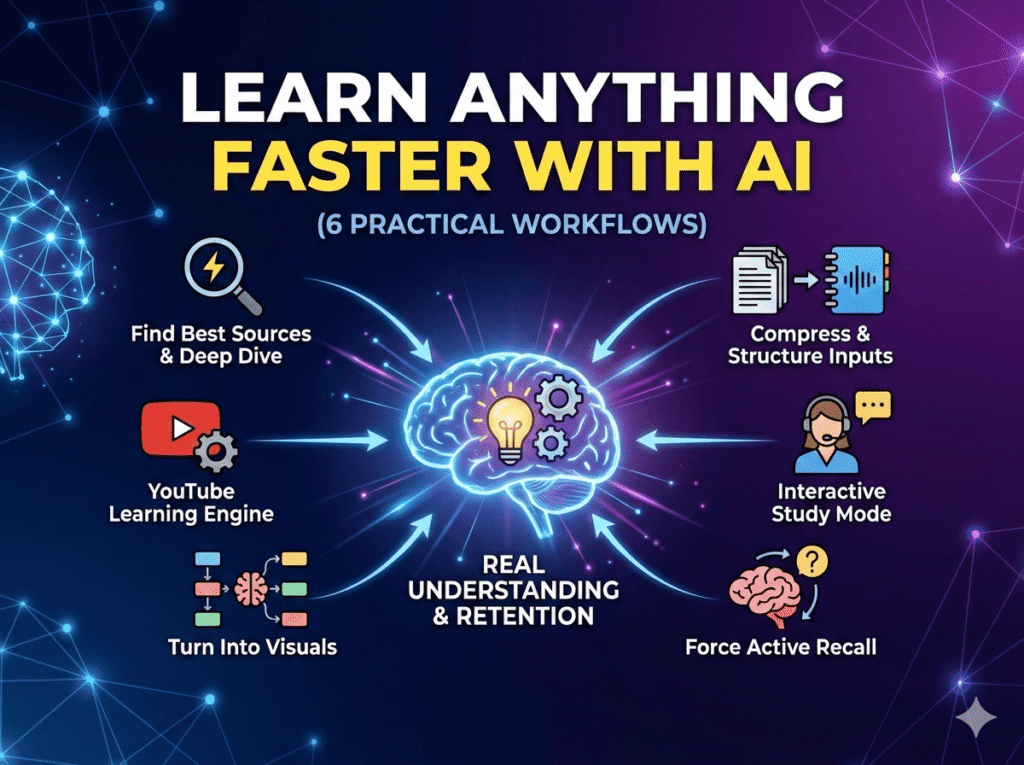
Learning Systems for Knowledge Workers: Neuroscience and AI Frameworks to Master Skills Faster and Stay Ahead in the AI Era
Table of Content
- Why Traditional Learning No Longer Works for Knowledge Workers in the AI Era
- The Core Components of High-Performance Learning Systems
- Neuroscience Foundations: How Your Brain Actually Acquires and Retains Complex Skills
- AI as a Learning Multiplier: Tools and Workflows That Enhance – Not Replace – Cognition
- Assessing Your Current Learning System: Quick Audits for Engineers and Analysts
- Building Block Protocols: Daily and Weekly Practices Backed by Evidence
- Advanced Learning Architectures: Spaced Repetition, Interleaving, and Deliberate Practice
- Skill Stacking Strategies: Creating Exponential Career Advantages
- Memory Systems and Retention Frameworks Optimized for Technical Professionals
- Integrating AI without Cognitive Offloading: Protect Your Critical Thinking
- Overcoming Common Learning Plateaus and Forgetting Curves
- Designing Your Personal Learning Operating System: Quarterly Planning and Review
- Measuring ROI: Metrics That Matter for Professional Development
- Long-Term Adaptation: Maintaining Peak Learning Capacity Past Age 40
- Conclusion
Why Traditional Learning No Longer Works for Knowledge Workers in the AI Era
Most knowledge workers have experienced the same frustrating cycle. You finish a course, highlight half a book, or spend weeks learning a new framework — only to realize months later that most of it never became usable knowledge.
At the same time, the environment keeps accelerating. AI capabilities evolve every quarter. Technical stacks shift faster than organizations can adapt. Entire workflows that felt modern two years ago already look outdated.
The problem is not a lack of intelligence or motivation. It is that traditional learning models were built for a slower world.
Lecture-heavy, passive learning approaches consistently produce weaker long-term retention than active learning systems. In technical fields, the half-life of knowledge has reportedly fallen from roughly 26 years in the 1960s to as little as 2–5 years today. Meanwhile, overreliance on tools like ChatGPT can reduce independent concept mastery once the AI layer disappears. Some studies have shown drops of roughly 17% in unaided performance after heavy AI-assisted work.
The broader labor market trends reinforce the urgency. Data from the World Economic Forum and McKinsey suggests that between 39% and 59% of core workplace skills could transform by 2030. For engineers, analysts, accountants, consultants, and other knowledge workers, learning is no longer a side activity. It is infrastructure.
The professionals who adapt fastest will not necessarily be the smartest. They will be the ones with the strongest learning systems.
This article explores neuroscience-backed and AI-enhanced frameworks that help knowledge workers acquire skills faster, retain them longer, and stay cognitively competitive in an increasingly automated world.
The Core Components of High-Performance Learning Systems
High performers rarely rely on motivation alone. They build systems that continue working even when motivation fades.
The most effective learning systems combine several core mechanisms:
- active retrieval
- spaced repetition
- rapid feedback loops
- deliberate error correction
- progressive difficulty
- structured reflection
Together, these mechanisms strengthen neural pathways far more efficiently than passive review or information consumption.
Elite learners also approach skill development as an integrated architecture rather than a collection of disconnected habits. They assess weaknesses, create repeatable protocols, measure outcomes, and continuously refine the system.
This aligns closely with the neuroplasticity principles described by researchers like Kleim and Jones, particularly:
- specificity
- repetition
- progression
- salience
- recovery
Just as importantly, effective systems respect the limitations of working memory. Most people can only manage a limited number of information units simultaneously — often between 3 and 9 meaningful chunks depending on expertise and cognitive load.
That means better learning is not about consuming more information. It is about organizing information into stronger mental models and more durable schema.
When done properly, the payoff compounds:
- faster skill acquisition
- improved retention
- clearer thinking under pressure
- higher adaptability
- accelerated career growth
Neuroscience Foundations: How Your Brain Actually Acquires and Retains Complex Skills
Your brain does not store knowledge like files in a cabinet. It constantly rewires itself based on what you repeatedly use, practice, and reinforce.
Every time you deeply engage with a difficult concept, the brain strengthens specific neural connections through mechanisms such as long-term potentiation (LTP). Over time, repeated learning also drives structural changes, including dendritic growth and stronger synaptic connectivity across hippocampal and cortical networks.
In practical terms, your brain physically changes as expertise develops.
This is especially important for technical professionals. Whether you are learning software architecture, financial modeling, cybersecurity analysis, or AI workflows, expertise is not just informational. It is neurological.
Research on both cognitive and motor learning consistently shows that variable practice tends to outperform repetitive blocked practice for long-term retention. When the brain must continually adapt between slightly different scenarios, neuronal coactivity improves and learning becomes more transferable.
That explains why solving twenty identical coding problems often produces weaker mastery than working through varied implementations that force deeper reasoning.
The brain also prunes unused pathways. Skills you stop retrieving gradually weaken, while frequently activated pathways become more efficient and automatic.
Understanding this changes how you approach professional development. Instead of fighting your cognitive limitations, you begin designing systems that align with how the brain naturally learns.
AI as a Learning Multiplier: Tools and Workflows That Enhance – Not Replace – Cognition
AI can either strengthen your thinking or quietly weaken it. The difference comes down to how you use it.
When knowledge workers actively collaborate with AI — questioning outputs, refining ideas, testing assumptions, and generating alternative explanations — cognitive engagement remains high. The brain still performs the core reasoning work.
But passive dependence creates a very different outcome.
Cognitive offloading occurs when external tools replace internal mental effort instead of supporting it. Over time, this reduces independent recall, verification behavior, and conceptual ownership.
Some studies show AI assistance can improve short-term task performance dramatically, even by more than 100% in certain contexts. Yet those gains often collapse if the learner never internalizes the underlying reasoning.
The most effective AI workflows treat AI as:
- a thinking partner
- a simulation environment
- a feedback engine
- a rapid explanation layer
- an ideation amplifier
Not as a substitute for cognition.
For example:
- ask AI to critique your solution rather than generate it first
- use AI to create analogies after you attempt understanding independently
- generate practice problems from real project contexts
- request alternative explanations for concepts you partially understand
Used correctly, AI becomes a genuine learning multiplier while preserving critical thinking and long-term retention.
Assessing Your Current Learning System: Quick Audits for Engineers and Analysts
Most professionals dramatically overestimate how much they actually retain.
Information exposure creates a dangerous illusion of competence. Recognizing a concept during review is not the same as being able to apply it independently under pressure.
A quick self-audit can reveal the real quality of your learning system.
Try testing yourself on:
- unaided recall of recent frameworks
- explanation quality without notes
- transfer ability across unfamiliar scenarios
- error frequency in repeated workflows
- retention after one or two weeks without review
You can also analyze recent project work. Where do mistakes repeatedly occur? Which concepts feel “familiar” but still require constant lookup? Which skills degrade fastest under stress?
These patterns expose gaps in consolidation and reveal where your current system is breaking down.
Working memory capacity and cognitive flexibility vary significantly between individuals, especially under heavy technical load. But regardless of baseline differences, deliberate retrieval and structured feedback consistently improve retention efficiency.
Before adding new productivity tools or learning frameworks, it helps to diagnose the bottlenecks first.
Building Block Protocols: Daily and Weekly Practices Backed by Evidence
The most sustainable learning systems usually look deceptively simple.
They are not built around occasional bursts of motivation. They are built around repeatable protocols that compound quietly over time.
Research continues to show that several foundational behaviors strongly influence neuroplasticity and learning performance:
- aerobic exercise
- high-quality sleep
- stress regulation
- focused review sessions
- immediate feedback
- environmental enrichment
Even short learning sessions can produce meaningful gains when practiced consistently. In many cases, 5–10 minutes of active recall and focused review deliver better long-term retention than infrequent marathon study sessions.
That happens partly because consolidation continues during sleep and downtime. The brain needs recovery periods to stabilize and strengthen newly formed pathways.
A practical starting framework might include:
- a 10-minute morning retrieval session
- one focused deep-work block for skill acquisition
- end-of-day reflection on errors and insights
- weekly review of weak areas
- scheduled recovery periods
Small protocols reduce friction. Low friction increases consistency. And consistency is ultimately what drives compounding expertise.
Advanced Learning Architectures: Spaced Repetition, Interleaving, and Deliberate Practice
Once foundational habits are stable, more advanced learning architectures become extremely powerful.
Spaced repetition remains one of the most evidence-supported methods for long-term retention. Reviewing information at expanding intervals helps counter the forgetting curve while strengthening consolidation pathways.
Research suggests that optimal review intervals often fall around 10–20% of the desired retention period. If you want to retain material for a year, reviews spaced strategically across weeks and months tend to outperform dense short-term repetition.
Interleaving adds another important layer.
Instead of practicing one skill in isolation for extended periods, interleaving mixes related domains or problem types together. This introduces contextual interference, which initially feels harder but produces stronger discrimination and transfer capabilities over time.
For technical professionals, that might mean alternating between:
- system design
- debugging
- architecture review
- algorithmic thinking
- communication exercises
- AI-assisted workflow analysis
Deliberate practice adds the final layer. This means focusing specifically on weaknesses, feedback loops, and “desirable difficulty” rather than comfortable repetition.
Elite performers rarely optimize for feeling productive. They optimize for adaptation.
That distinction matters.
Skill Stacking Strategies: Creating Exponential Career Advantages
In the AI era, isolated expertise becomes increasingly fragile.
A single technical skill can be automated, outsourced, or commoditized surprisingly quickly. But combinations of skills create leverage that is much harder to replace.
This is where skill stacking becomes strategically important.
World Economic Forum projections suggest that nearly 39% of core workplace skills will shift significantly by 2030. Professionals who combine technical depth with communication ability, systems thinking, AI literacy, and domain expertise create far more resilient career positioning.
T-shaped and M-shaped skill profiles are especially valuable because they balance specialization with cross-domain adaptability. In many industries, these profiles command salary premiums estimated between 20% and 40% while also enabling smoother career pivots.
For example:
- a software engineer who understands behavioral psychology
- an accountant fluent in AI workflow automation
- a data analyst with strong storytelling ability
- a consultant who combines technical systems thinking with neuroscience-informed decision design
These combinations produce nonlinear value.
Over time, compound learning creates integrated expertise rather than disconnected competencies. That integration improves adaptability, leadership potential, and long-term career resilience.
Memory Systems and Retention Frameworks Optimized for Technical Professionals
Retention is where learning either becomes career capital or disappears entirely.
Working memory operates through several interconnected systems:
- the phonological loop
- the visuospatial sketchpad
- the central executive
- the episodic buffer
Together, these systems manage the temporary cognitive workspace required for technical reasoning and complex problem solving.
But working memory alone is fragile. Durable expertise only emerges when information transfers into long-term memory through repeated retrieval and contextual application.
This is why passive rereading consistently underperforms retrieval-based methods.
For technical professionals, retention improves significantly when new concepts are linked to existing mental structures:
- connecting new frameworks to prior systems
- mapping abstractions visually
- explaining concepts aloud
- teaching teammates
- applying ideas inside real projects
Associative learning creates stronger retrieval pathways because the brain stores meaning more effectively than isolated information.
The goal is not memorization for its own sake. The goal is reliable recall under real-world cognitive pressure.
Integrating AI without Cognitive Offloading: Protect Your Critical Thinking
The greatest long-term risk of AI is not replacement. It is cognitive dependency.
When professionals rely too heavily on AI-generated answers, they often stop performing the mental operations required for deep understanding:
- verification
- synthesis
- abstraction
- reasoning
- error detection
Over time, this weakens independent problem-solving ability.
Interestingly, research suggests that individuals with higher confidence in their own reasoning tend to engage more critically with AI outputs. They verify more aggressively, challenge assumptions more often, and integrate information more actively.
That creates a useful principle for knowledge workers:
Use AI to extend cognition, not replace it.
A healthier workflow often looks like this:
- Attempt the reasoning independently.
- Use AI for critique, expansion, or alternative perspectives.
- Compare approaches.
- Reconstruct the idea from memory later.
This preserves active neural engagement while still capturing AI’s speed advantages.
The professionals who thrive in the next decade will likely be those who combine high AI fluency with strong independent cognition.
Overcoming Common Learning Plateaus and Forgetting Curves
Almost everyone encounters learning plateaus eventually.
Progress slows. Concepts stop “clicking.” Motivation drops. It begins to feel like effort no longer produces meaningful returns.
In reality, plateaus are often signals that the brain has adapted to the current difficulty level.
The forgetting curve also compounds the frustration. Without strategic retrieval, retention declines rapidly within days or weeks.
Several evidence-backed interventions help break through these stagnation periods:
- increasing contextual variation
- introducing desirable difficulty
- shifting learning modalities
- reducing passive review
- emphasizing error analysis
- changing environments or constraints
Sometimes the problem is not insufficient effort. It is insufficient cognitive challenge.
Periods of productive struggle often trigger stronger plasticity and deeper consolidation than smooth, comfortable repetition.
Plateaus are not proof that learning has stopped. They are usually indicators that the system needs recalibration.
Designing Your Personal Learning Operating System: Quarterly Planning and Review
High-performing professionals rarely leave learning entirely to chance.
They create operational systems around it.
A strong personal learning operating system includes:
- quarterly skill planning
- weekly review cycles
- project-based application
- feedback integration
- recovery management
- long-term measurement
The neuroscience principles remain consistent:
- specificity
- progression
- repetition
- recovery
- environmental enrichment
What changes is how deliberately you structure them.
One effective strategy is habit stacking — attaching learning behaviors to existing workflows. For example:
- reviewing technical notes immediately after meetings
- running retrieval sessions before coding
- journaling insights after project retrospectives
- generating AI-assisted quizzes from active workstreams
This reduces friction while embedding learning directly into professional life.
Quarterly reviews also matter because they prevent drift. Skill priorities evolve quickly in fast-moving industries, and without periodic recalibration, many professionals continue optimizing outdated competencies long after market value declines.
Your learning system should evolve as aggressively as your industry does.
Measuring ROI: Metrics That Matter for Professional Development
Most people measure learning poorly.
They track hours spent, courses completed, or books consumed — metrics that say very little about actual capability.
More meaningful indicators include:
- unaided recall accuracy
- speed of problem solving
- transfer across unfamiliar scenarios
- reduction in cognitive load
- ability to explain concepts clearly
- project complexity handled successfully
- improved decision quality under pressure
Some of the best signals are indirect.
For example:
- deeper sustained focus
- fewer repeated mistakes
- faster onboarding into new domains
- increased confidence during ambiguity
- greater adaptability during technological change
Long-term ROI also appears in career opportunities:
- expanded leadership responsibility
- faster pivots into emerging fields
- stronger professional leverage
- higher-value problem ownership
Ultimately, the goal is not information accumulation. It is cognitive capability that compounds professionally over time.
Long-Term Adaptation: Maintaining Peak Learning Capacity Past Age 40
Cognitive performance does not suddenly disappear after 40. But maintaining high learning capacity does become increasingly dependent on deliberate behavior.
Neuroplasticity remains active throughout life when properly supported.
Research consistently shows that several factors help preserve learning performance with age:
- physical exercise
- intellectual challenge
- stress management
- social engagement
- sleep quality
- enriched environments
Equally important is mindset.
Negative beliefs about aging and cognitive decline can become self-reinforcing. Professionals who continue engaging with difficult problems, learning new systems, and adapting to technological change often maintain strong cognitive flexibility far longer than expected.
In many cases, experienced professionals possess advantages younger workers lack:
- stronger mental models
- deeper pattern recognition
- broader contextual judgment
- more refined decision-making heuristics
When combined with deliberate learning systems and AI-enhanced workflows, these advantages can become extraordinarily powerful.
Conclusion
Learning systems for knowledge workers are no longer optional.
In an AI-driven economy, your ability to acquire, retain, and apply complex skills faster than the surrounding rate of change increasingly determines your professional trajectory.
The good news is that learning itself is trainable.
By combining neuroscience-backed principles with intelligent AI integration, knowledge workers can build systems that improve retention, accelerate skill acquisition, strengthen critical thinking, and create long-term career resilience.
The frameworks in this article provide the architecture. Consistent execution is what creates the compounding advantage.
Start small:
- run a learning audit this week
- create one repeatable daily protocol
- introduce structured retrieval
- review progress quarterly
- refine continuously
Over a 12–24 month period, the compound effect becomes difficult to ignore.
Your brain is still the highest-leverage professional asset you own.
Treat it like infrastructure.