
The AI-Augmented Knowledge Worker: Neuroscience-Backed Systems to 10x Cognitive Output Without Burnout
You sit down to solve a difficult problem.
Maybe you are debugging a stubborn production issue. Maybe you are reviewing quarterly forecasts, untangling financial anomalies, or preparing recommendations for a client presentation that carries real consequences.
Five minutes later, your attention is fractured.
You are bouncing between tabs, prompting AI tools, reviewing outputs, cross-checking assumptions, and wondering something that quietly worries a growing number of professionals:
Is AI actually making me sharper—or slowly making me cognitively lazy?
That tension defines modern knowledge work.
AI offers extraordinary leverage. Used well, it compresses hours of research, drafting, analysis, and synthesis into minutes. But the same systems that increase output can also erode focus, weaken independent thinking, and create a constant state of cognitive fragmentation.
The professionals who thrive over the next decade will not simply “use AI.”
They will build deliberate human-AI systems that increase output without sacrificing judgment, creativity, or mental resilience.
This guide explores how to do exactly that using neuroscience-backed principles, practical workflow design, and sustainable cognitive architecture. Whether you are a software engineer, accountant, analyst, consultant, strategist, or technical operator, the goal is the same: amplify your thinking without burning yourself out in the process.
Table of Content
- What It Really Means to Be an AI-Augmented Knowledge Worker
- Why Traditional Productivity Advice Fails in the AI Era
- The Neuroscience of Human-AI Symbiosis: How Your Brain Actually Changes
- Core Principles of Effective Human-AI Collaboration
- Designing Your Personal AI-Augmented Cognitive Architecture
- AI as Executive Function Support: Offloading Without Atrophying
- Building High-Leverage AI Workflows for Engineers and Analysts
- Maintaining Critical Thinking and Creativity When Working With AI
- The AI + Deep Work Integration Protocol
- Measuring and Optimizing Your Cognitive Output with AI
- Common Failure Modes and How Elite Performers Avoid Them
- Advanced AI Thinking Partner Systems for Complex Problem Solving
- Creating Your 90-Day AI-Augmentation Implementation Plan
- The Future of Knowledge Work: Positioning Yourself as Irreplaceable
What It Really Means to Be an AI-Augmented Knowledge Worker
Being an AI-augmented knowledge worker goes far beyond occasionally opening ChatGPT or accepting Copilot suggestions.
True augmentation means treating AI as a cognitive co-processor—an external system that extends your capabilities while you remain firmly responsible for judgment, verification, prioritization, and decision-making.
That distinction matters more than most people realize.
Recent data shows that roughly 75% of global knowledge workers now use generative AI, with nearly half adopting it within the previous six months. At the same time, industries with high AI exposure are seeing three times higher revenue-per-worker growth and wage premiums reaching 56% for professionals with strong AI skills.
Yet the broader workforce still has not fully adapted. While 91% of organizations claim some form of AI adoption, only 21% of U.S. workers actively use AI in meaningful daily workflows.
That gap—between access and mastery—is where the real advantage lives.
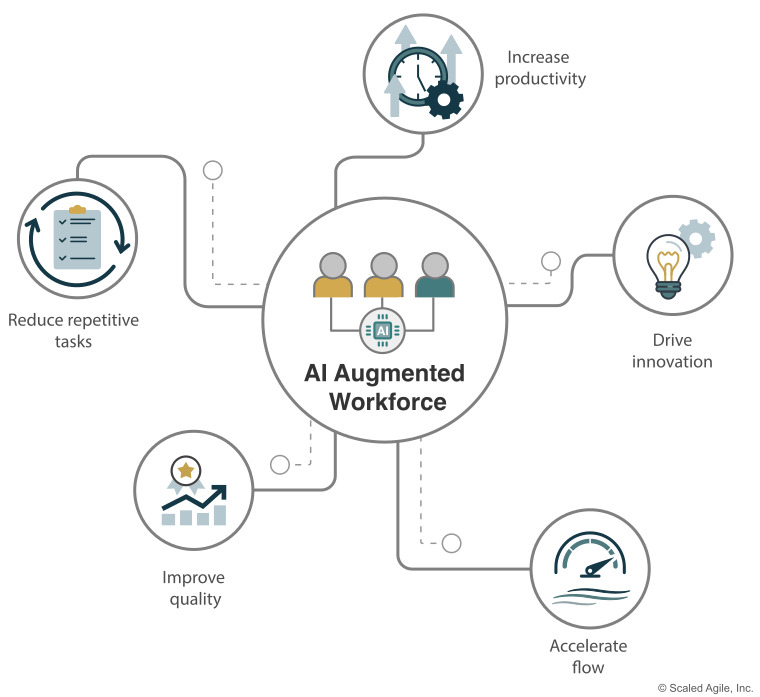
The highest-performing professionals are not merely faster workers. They are becoming systems orchestrators. They design workflows where AI handles repetitive or low-leverage cognitive tasks while human attention is reserved for strategic thinking, pattern recognition, communication, and judgment.
In practical terms, the role of the modern knowledge worker is shifting from information processor to cognitive architect.
Why Traditional Productivity Advice Fails in the AI Era
Most traditional productivity systems were designed for a very different environment.
Time-blocking, inbox zero, Pomodoro timers, and task batching all emerged during a period when human attention—not machine acceleration—was the primary bottleneck.
AI changes the equation completely.
The problem is not simply that work moves faster. It is that the scope of work expands at the same time.
Engineers using AI tools often complete tasks dramatically faster, yet suddenly face larger pull requests, more review cycles, and rising coordination overhead. Some teams report PR sizes increasing by as much as 154%.
The experience feels deceptively productive at first. You clear tasks faster, generate more drafts, process more information, and answer more requests. Then the treadmill speeds up.
The cognitive environment becomes noisier, not calmer.
Traditional productivity advice also fails to account for cognitive offloading—the brain’s tendency to conserve effort when external systems are available. Studies increasingly show that frequent AI reliance can reduce critical engagement if users begin outsourcing thinking itself instead of only outsourcing mechanics.
Individual productivity may rise anywhere from 21% to 98% depending on the task, but organizational gains often lag because human oversight becomes the new bottleneck.
The old systems were optimized for manual throughput. Modern professionals need systems optimized for cognitive sustainability.
The Neuroscience of Human-AI Symbiosis: How Your Brain Actually Changes
Your brain adapts to repeated AI use, whether you notice it or not.
That adaptation can either strengthen cognition or slowly weaken it depending on how you engage with the technology.
Passive dependence activates what neuroscientists describe as long-term depression (LTD), where neural pathways weaken from underuse. Active co-creation, by contrast, supports long-term potentiation (LTP), strengthening learning, memory formation, and cognitive flexibility.
In simple terms: the brain reinforces what it repeatedly practices.
If AI becomes a substitute for thinking, your cognitive systems adapt accordingly. If AI becomes a collaborative thinking environment, your brain can actually become more capable over time.
Some of the most concerning findings come from MIT EEG research examining AI-assisted writing. Participants relying heavily on ChatGPT showed significantly lower brain connectivity, nearly halved alpha/theta wave activity, and dramatically weaker memory recall—up to 83% poorer retention for AI-assisted material compared to unaided writing.
That does not mean AI is inherently harmful.
It means the mode of interaction matters.
Research also suggests excessive AI assistance can reduce relevant cognitive load by roughly 32% during tasks such as writing and synthesis. Short term, this feels efficient. Long term, it risks cognitive atrophy if independent reasoning is no longer exercised regularly.
The healthiest model is not replacement. It is symbiosis.
AI should amplify thought—not replace the mental effort required to build expertise.
Core Principles of Effective Human-AI Collaboration
Strong human-AI systems tend to share three foundational principles.
1. Maintain Strong Cognitive Ownership
Research from Microsoft involving 319 knowledge workers found that people with higher confidence in their own expertise were significantly more likely to critically evaluate AI outputs instead of blindly accepting them.
Confidence changes behavior.
Professionals who trust their own reasoning tend to interrogate AI responses, challenge assumptions, and refine outputs collaboratively. Those who over-trust AI are more likely to disengage mentally.
The goal is not skepticism for its own sake. It is active participation.
2. Stay Actively Engaged During AI Use
The difference between augmentation and dependency often comes down to interaction style.
Passive acceptance weakens critical thinking over time. Active refinement strengthens it.
Question outputs. Rewrite conclusions. Stress-test assumptions. Ask the model to defend opposing perspectives. Force deeper reasoning loops instead of accepting first-pass answers.
Treat AI like an intellectually useful colleague—not an oracle.
3. Build Deliberate Practice Into Your Workflow
Education and skill development consistently buffer against cognitive decline associated with over-reliance on automation.
Higher-skilled workers generally maintain stronger independent reasoning because they continue exercising domain expertise rather than surrendering it.
The professionals who benefit most from AI are rarely the ones who depend on it most heavily. They are the ones who combine strong foundations with deliberate augmentation.
Designing Your Personal AI-Augmented Cognitive Architecture
Think of your mind as an operating system.
Most people integrate AI reactively. High-performing professionals integrate it architecturally.
That means designing repeatable systems for the flow of information through your cognitive environment.
Research increasingly shows that “AI-user skills” such as prompting, verification, synthesis, and workflow orchestration are spreading across industries, while deeper AI development skills remain concentrated in technical fields. The strongest professionals build competency in both.
When generative AI is integrated intentionally rather than casually, knowledge workers can unlock an estimated $7,800 in annual productivity gains through improved workflows alone.
The key shift is this:
Your primary cognitive effort should move away from raw information gathering and toward verification, synthesis, prioritization, and strategic interpretation.
This creates what some researchers describe as extended executive cognition—the combination of your biological cognition plus trusted external AI systems.
A practical starting point is surprisingly simple:
Map your recurring cognitive loops.
For example:
- research
- analysis
- synthesis
- communication
- review
- decision-making
Then identify where friction consistently appears.
Maybe AI helps accelerate exploratory research. Maybe it structures rough drafts faster. Maybe it reduces repetitive formatting or summarization work.
The goal is not maximum automation.
The goal is preserving your highest-value cognition for the work that truly requires human judgment.
AI as Executive Function Support: Offloading Without Atrophying
One of AI’s most valuable uses is executive function support.
It can reliably handle reminders, organizational structure, formatting, scheduling, categorization, and repetitive procedural tasks that consume mental bandwidth.
Used strategically, this frees cognitive capacity for higher-order thinking.
But there is a line between productive offloading and cognitive disengagement.
Research shows cognitive offloading through AI has a measurable negative correlation with critical thinking ability, with one study reporting an indirect effect of b = -0.25, particularly among younger users.
Less-experienced developers often experience rapid early productivity gains—sometimes between 27% and 39%—but those gains can flatten if independent problem-solving skills stop developing underneath the automation layer.
The solution is selective offloading.
Let AI manage operational friction. Keep ownership over:
- reasoning
- interpretation
- prioritization
- architecture
- strategic decisions
- final synthesis
You want AI handling cognitive overhead—not replacing cognitive responsibility.
Building High-Leverage AI Workflows for Engineers and Analysts
The productivity gains from AI-assisted workflows are real.
Engineers using AI tools often complete 21% more tasks and merge nearly 98% more pull requests. Some studies report programmers producing 126% more projects per week under AI-assisted workflows.
But the gains come with tradeoffs.
Review time frequently rises alongside output volume. Larger PRs increase coordination costs. Code quality can also decline if verification systems are weak, with some research pointing to roughly 9% more bugs under poorly managed AI-assisted development.
The professionals seeing the best long-term results typically follow structured workflows rather than improvising with prompts all day.
A strong engineering workflow often looks like this:
- Define context and constraints clearly
- Generate candidate solutions with AI
- Review line-by-line for reasoning quality
- Refine iteratively
- Run automated tests as mandatory gates
- Reserve architecture and edge-case decisions for humans
Analysts can apply nearly identical systems.
Use AI for:
- exploratory analysis
- summarization
- first-pass pattern detection
- formatting
- scenario generation
Reserve human attention for:
- interpretation
- stakeholder nuance
- strategic implications
- communication
- decision framing
AI accelerates information processing. Human expertise determines whether the conclusions are actually useful.
Maintaining Critical Thinking and Creativity When Working with AI
One of the biggest hidden risks of constant AI use is cognitive passivity.
Frequent AI users consistently show weaker critical-thinking engagement when they begin outsourcing reasoning itself instead of simply outsourcing mechanics.
The MIT findings are particularly important here. Participants who relied exclusively on their own thinking demonstrated the strongest neural connectivity and memory retention. Heavy AI users underperformed across neural, behavioral, and linguistic measures.
But the takeaway is not “avoid AI.”
It is “avoid intellectual autopilot.”
Creativity, in particular, suffers when AI becomes the starting point for every idea.
A better approach is to separate divergence from convergence.
Before using AI:
- generate your own hypotheses
- outline rough ideas
- identify assumptions
- sketch first-pass frameworks
Then use AI to:
- expand possibilities
- challenge blind spots
- stress-test reasoning
- explore alternatives
- accelerate refinement
This preserves creative ownership while still benefiting from computational leverage.
The most valuable insights rarely emerge from accepting the first generated answer.
They emerge from thoughtful interaction between human intuition and machine amplification.
The AI + Deep Work Integration Protocol
AI tools can quietly destroy deep work if boundaries are not intentional.
Every prompt, notification, generated response, and context switch fragments attention a little further. Over time, many professionals find themselves trapped in a state of continuous partial focus.
The result is what some researchers now call the “infinite workday.”
Knowledge workers report unsustainable pace levels despite widespread AI adoption, with roughly 68% describing rising pressure and cognitive overload.
A better approach is structured AI-assisted deep work.
Here is a practical protocol:
Step 1: Define a Deep Work Block
Set aside 90-120 minutes for uninterrupted cognitive work.
Step 2: Preload Context
Before starting, provide AI systems with relevant context, documentation, constraints, or objectives.
Step 3: Use AI Only for Bounded Subtasks
Inside the block, avoid random prompting spirals. Use AI intentionally for:
- summarization
- debugging assistance
- scenario generation
- verification
- structured brainstorming
Step 4: Finish With Human Synthesis
End each session with 10 minutes of AI-free consolidation:
- summarize conclusions
- document reasoning
- identify next actions
- reinforce memory through independent reflection
This final step matters more than most people realize. It strengthens retention and helps prevent passive dependence.
Deep work still matters in the AI era. If anything, it matters more.
Measuring and Optimizing Your Cognitive Output with AI
What gets measured improves—especially in cognitive systems.
AI-exposed industries are already producing roughly three times higher revenue-per-worker growth, but output alone is an incomplete metric.
Developers with strong AI adoption may touch 47% more pull requests daily, yet quality and cognitive sustainability remain equally important.
Most professionals still operate reactively. Only about 38% of knowledge workers use generative AI consistently every day in structured workflows.
That creates an opportunity for deliberate optimization.
Track metrics that capture both performance and cognitive health:
- tasks completed versus cognitive energy spent
- output quality and error rates
- deep work hours maintained
- review or peer-feedback quality
- subjective mental clarity
- recovery quality after intensive work periods
The goal is not maximum activity.
It is sustainable cognitive leverage.
If your output rises while your mental clarity collapses, the system is failing.
Common Failure Modes and How Elite Performers Avoid Them
Most AI implementations underperform for predictable reasons.
Research suggests roughly 70-80% of AI initiatives fail due to poor integration rather than weak technology.
At the individual level, the most dangerous failure mode is cognitive debt.
Cognitive debt accumulates when short-term productivity gains mask gradual capability decline underneath. You become faster while becoming less capable independently.
That tradeoff is easy to miss until complex work exposes the gap.
Elite performers avoid this trap by maintaining strong verification habits and preserving intellectual ownership of decisions.
They treat AI as a sparring partner—not a replacement thinker.
Several practical safeguards help:
- scheduled “AI-off” sessions
- deliberate independent problem-solving
- regular skill audits
- pre-mortem analysis on AI outputs
- manual synthesis before final delivery
The goal is not resisting automation.
The goal is preserving the cognitive abilities that make automation valuable in the first place.
Advanced AI Thinking Partner Systems for Complex Problem Solving
For highly complex or ambiguous work, AI becomes most useful when it evolves from assistant into thinking partner.
This is where augmentation becomes genuinely powerful.
Research suggests active human-AI co-creation strengthens long-term potentiation and cognitive engagement far more effectively than passive consumption.
Newer professionals often experience especially strong gains—sometimes between 27% and 39%—when AI is framed as collaborative reasoning support rather than replacement.
A strong thinking-partner workflow usually follows this pattern:
- You define the problem frame
- AI explores possibilities and perspectives
- You evaluate tradeoffs and assumptions
- AI stress-tests reasoning or simulates counterarguments
- You synthesize the final direction
This preserves human stewardship while dramatically expanding exploratory bandwidth.
The machine generates possibilities.
You generate judgment.
That distinction is what keeps high-level knowledge work deeply human.
Creating Your 90-Day AI-Augmentation Implementation Plan
Most professionals know they should adapt to AI. Far fewer build structured systems for doing it well.
That creates a major opportunity.
Roughly 77% of employers now plan AI reskilling initiatives, yet only 13% of employees currently receive meaningful training. At the same time, skill requirements in AI-exposed jobs are evolving roughly 66% faster than before.
The professionals who move deliberately now will compound advantages for years.
A practical 90-day implementation plan can look like this:
Days 1-30: Establish Your Baseline
- audit recurring workflows
- identify cognitive bottlenecks
- learn core AI tools deeply
- measure current focus and output patterns
Days 31-60: Redesign Workflows
- integrate AI into repeatable systems
- create structured prompting frameworks
- implement deep work boundaries
- establish verification routines
Days 61-90: Optimize and Expand
- track cognitive and performance metrics
- refine high-leverage workflows
- build advanced thinking-partner systems
- identify weak points in reasoning or retention
Review progress weekly.
Not emotionally. Operationally.
The strongest systems evolve through measurement, iteration, and honest feedback loops.
The Future of Knowledge Work: Positioning Yourself as Irreplaceable
The future of knowledge work will not belong to professionals who simply “know how to use AI.”
That bar is already becoming too low.
Roughly 40% of global jobs—and as much as 60% in advanced economies—are expected to transform significantly as AI capabilities expand. Meanwhile, professionals with strong AI skills already command wage premiums that can reach 56%.
But the most defensible value will not come from prompting alone.
It will come from combining:
- deep domain expertise
- systems thinking
- strategic judgment
- communication skill
- cognitive adaptability
- AI orchestration capability
Routine cognitive tasks will continue becoming increasingly automated.
Human leverage will increasingly concentrate around:
- interpretation
- judgment
- ambiguity navigation
- creativity
- trust
- systems integration
The professionals who thrive will not compete against AI directly.
They will build workflows where human cognition and machine intelligence reinforce each other.
That is the real future of augmentation.
Conclusion
Becoming an AI-augmented knowledge worker is not about adopting more tools or generating more output.
It is about designing a cognitive system that remains sustainable under increasing informational pressure.
The goal is not merely efficiency.
The goal is preserving the quality of your thinking while expanding the scale of what you can accomplish.
Start small.
Implement one protocol from this guide this week. Measure what changes. Observe how your focus, output quality, and mental clarity respond. Then iterate deliberately from there.
Over time, the professionals who win in the AI era will not necessarily be the ones who automate the most.
They will be the ones who learn how to think better alongside intelligent systems without surrendering the human capabilities that matter most.