
Neuroscience-Based Burnout Recovery Systems for Knowledge Workers: Rebuild Cognitive Performance in the AI Era
You’re shipping code at 2 AM again. Slack messages bleed into dinner. Your brain feels strangely foggy even after eight hours of sleep, and simple decisions suddenly require more effort than they should.
At first, you tell yourself it’s temporary. A busy sprint. A demanding quarter. Another product launch.
But eventually the pattern becomes impossible to ignore.
You’re still producing. Still functioning. Still hitting deadlines. Yet mentally, something feels off — slower recall, weaker focus, reduced creativity, shorter patience, heavier cognitive fatigue.
This isn’t ordinary tiredness. And for many knowledge workers, it isn’t laziness or lack of discipline either.
It’s burnout amplified by the cognitive demands of the AI era.
Today’s engineers, analysts, accountants, consultants, researchers, and technical managers aren’t just doing deep work anymore. They’re constantly verifying AI outputs, juggling fragmented workflows, switching contexts across platforms, and operating inside environments where productivity expectations keep rising faster than recovery capacity.
That combination changes how burnout develops — and how recovery needs to work.
If you’re tired of generic advice like “just take a break” or “practice self-care,” this guide approaches burnout differently. We’ll look at neuroscience-based burnout recovery systems specifically designed for high-output knowledge workers who think in systems, workflows, and measurable outcomes.
You’ll learn:
- why cognitive burnout behaves differently in AI-augmented workplaces
- how chronic overload impacts executive function and neurological performance
- why willpower-based recovery usually fails
- practical recovery systems grounded in neuroscience
- how to use AI to reduce mental load instead of increasing it
- how to build long-term resilience without sacrificing ambition or performance
The goal isn’t to work less forever.
The goal is to rebuild sustainable cognitive performance before your brain forces the issue for you.
Table of Content
- The Hidden Cost of High-Output Knowledge Work: Why Burnout Hits Harder in the AI Era
- Burnout vs. Cognitive Overload: How AI Tools Are Changing the Game
- Early Warning Signs Most Knowledge Workers Miss (And How to Test Yourself)
- The Neuroscience of Burnout: Prefrontal Cortex Depletion, Dopamine Dysregulation, and Allostatic Load
- Why Willpower-Based Recovery Fails — And What Actually Works for Technical Professionals
- Immediate Recovery Protocol: 72-Hour Cognitive Reset System
- Micro-Recovery Systems: 5–15 Minute Interventions That Compound
- Rebuilding Executive Function: Neuroscience-Optimized Protocols for Focus and Decision-Making
- AI as a Recovery Ally: Tools and Workflows That Reduce Cognitive Load Instead of Increasing It
- Designing Your Personal Burnout Recovery Operating System
- Measuring Recovery: Cognitive Metrics, Biomarkers, and Performance Baselines That Matter
- Resilience Architecture: Building Antifragile Mental Systems for Long-Term High Performance
- Preventing Relapse: Integration Strategies for Demanding Roles and AI-Augmented Workflows
- Case Studies: How Engineers and Analysts Rebuilt Performance After Severe Burnout
The Hidden Cost of High-Output Knowledge Work: Why Burnout Hits Harder in the AI Era
Burnout isn’t new. What’s changed is the intensity, speed, and neurological pressure surrounding modern knowledge work.
A 2025 LeadDev survey found that 22% of engineering leaders and developers were experiencing critical burnout levels, while another 24% reported moderate burnout symptoms. At the same time, 38% said their working hours had increased because of layoffs, AI integration pressures, and expanding output expectations.
The broader tech industry reflects the same pattern. Burnout symptoms among tech workers climbed to 68% in 2024 surveys — a dramatic increase from 49% only three years earlier.
AI was supposed to reduce workload. In many organizations, it simply raised the performance baseline.
Instead of eliminating cognitive effort, AI often multiplies it. Workers now spend significant mental energy reviewing generated outputs, validating accuracy, managing fragmented toolchains, and maintaining constant responsiveness across communication systems.
The result is a form of chronic cognitive taxation that accumulates quietly.
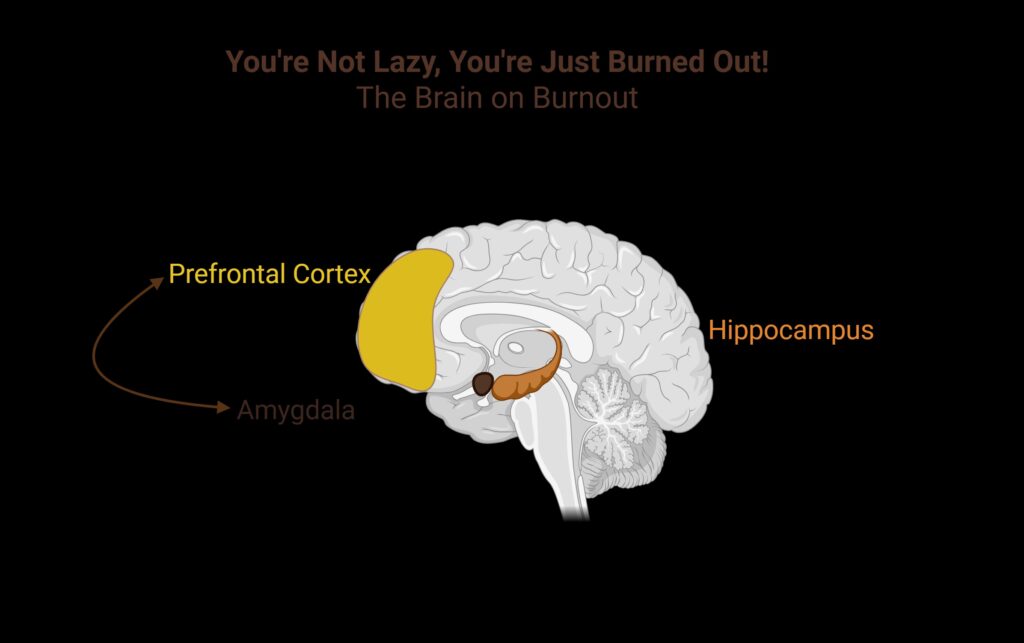
For knowledge workers, this creates elevated allostatic load — the cumulative physiological burden caused by repeated stress and adaptation demands. Constant context-switching, interrupted attention, and persistent verification loops accelerate mental fatigue and place sustained pressure on the prefrontal cortex, the brain region responsible for executive function, planning, decision-making, and focus.
That’s why many high performers feel strangely exhausted even when they’re technically “doing less physical work” than previous generations.
Your brain is spending enormous energy managing fragmentation.
And over time, that fragmentation compounds into slower thinking, reduced creativity, weaker working memory, emotional irritability, and a persistent sense that your cognitive sharpness is fading.
A useful exercise: review the last two weeks of your workdays and estimate how much uninterrupted deep work you actually completed versus how often your attention shifted between Slack, meetings, email, AI tools, dashboards, tickets, notifications, and verification tasks.
Most professionals discover the same thing:
they’re not exhausted because they worked too many hours alone.
They’re exhausted because their nervous system never fully exits task-switching mode.
Burnout vs. Cognitive Overload: How AI Tools Are Changing the Game
Burnout and cognitive overload overlap heavily, but they are not identical.
That distinction matters because recovery strategies differ depending on which system is failing first.
Research from Harvard Business Review involving roughly 1,500 workers identified what many professionals now describe as “AI brain fry” — a state marked by elevated cognitive load, mental fatigue, verification exhaustion, and increased decision errors caused by managing multiple AI tools alongside existing responsibilities.
In other words, AI didn’t necessarily replace work. It expanded the sphere of accountability surrounding the work.
You still own the outcome. You simply manage additional layers now:
- prompt construction
- output validation
- error detection
- context management
- workflow coordination
- rapid switching between human and machine reasoning
Focus time in AI-enabled workplaces has already dropped to a three-year low in several workplace studies. That matters because uninterrupted focus is one of the primary conditions required for cognitive recovery during demanding intellectual work.
Classic burnout often begins with emotional exhaustion.
AI-driven cognitive overload tends to impair executive function first.
That’s why many technically skilled professionals notice:
- declining concentration
- weaker memory recall
- slower debugging
- reduced analytical clarity
- rising mental friction
before they feel emotionally “burned out” in the traditional sense.
A practical distinction helps here:
If you feel emotionally drained but can still concentrate intensely when necessary, you may primarily be dealing with overload.
If sustained focus itself feels neurologically difficult — even under pressure — burnout is likely progressing deeper into cognitive impairment territory.
That’s the stage where recovery needs to become systematic rather than reactive.
Early Warning Signs Most Knowledge Workers Miss (And How to Test Yourself)
High performers are notoriously bad at recognizing burnout early.
In technical fields especially, people often normalize chronic strain because productivity remains temporarily intact. They compensate harder. Work longer. Push deeper into stimulation and caffeine.
Meanwhile, cognitive performance quietly deteriorates underneath the surface.
The earliest warning signs are often neurological rather than emotional:
- impaired concentration
- increased forgetfulness
- slower recall speed
- rising task-switching errors
- reduced cognitive flexibility
- lower frustration tolerance
These changes frequently appear weeks before full exhaustion becomes obvious.
The Shirom-Melamed Burnout Questionnaire identifies scores above 4.4 as severe burnout risk, but many professionals experience measurable cognitive decline long before reaching formal burnout thresholds.
Physical symptoms also emerge earlier than most people expect:
- persistent low energy
- shallow or fragmented sleep
- headaches
- elevated muscle tension
- unusual irritability
- reduced stress recovery
Engineers and analysts often notice more subtle signals first:
- debugging familiar problems takes longer
- writing quality drops
- architecture decisions feel mentally heavier
- analytical clarity weakens
- simple mistakes increase
Many practitioners report noticing these changes four to six weeks before overt burnout becomes undeniable.
A simple self-assessment protocol can help catch problems early:
- Track debugging or problem-solving time on familiar tasks for one week
- Rate your concentration daily on a 1–10 scale
- Record moments where you think, “I know this, but I can’t retrieve it quickly”
- Monitor how often you impulsively switch tasks during focused work
Even a 15–20% decline in cognitive consistency is worth paying attention to.
Recovery is dramatically easier when you intervene during early degradation instead of waiting for complete collapse.
The Neuroscience of Burnout: Prefrontal Cortex Depletion, Dopamine Dysregulation, and Allostatic Load
Burnout is not simply psychological. It’s neurological.
Chronic stress changes how the brain functions — and over time, how it physically organizes itself.
Research shows prolonged stress exposure contributes to structural remodeling in the prefrontal cortex, including thinning in regions responsible for executive control, planning, inhibition, and working memory. At the same time, stress weakens regulatory control over the amygdala, increasing emotional reactivity and threat sensitivity.
For knowledge workers, that combination is brutal.
The very systems required for deep thinking, strategic planning, emotional regulation, and complex decision-making become less efficient under sustained overload.
Burnout also disrupts dopamine regulation.
This matters more than most people realize.
Dopamine isn’t just about pleasure. It plays a central role in motivation, reward prediction, effort allocation, and sustained cognitive engagement. When dopamine pathways become dysregulated under chronic stress, work starts feeling simultaneously harder and less rewarding.
You exert more effort for weaker cognitive return.
That’s one reason burned-out professionals often describe feeling “flat,” mentally resistant, or disconnected from work they previously enjoyed.
EEG studies add another layer to this picture. Burnout patients frequently recruit significantly more neural resources to complete the same cognitive tasks as non-burned-out individuals. Altered frontal midline theta activity suggests impaired conflict monitoring and reduced executive efficiency.
In practical terms, your brain begins consuming more energy to maintain baseline performance.
Simple tasks feel strangely expensive.
Decision fatigue accelerates. Working memory degrades. Emotional resilience shrinks. Creativity narrows.
This is why burnout cannot be solved through guilt, self-criticism, or motivational slogans.
You are not dealing with a character flaw.
You are dealing with a predictable neurological response to sustained cognitive strain without adequate recovery architecture.
Why Willpower-Based Recovery Fails – And What Actually Works for Technical Professionals
One of the biggest mistakes high performers make during burnout recovery is assuming they simply need more discipline.
Unfortunately, the brain systems required for discipline are often the exact systems already impaired.
Executive functions — planning, inhibition, sustained attention, impulse control — depend heavily on the prefrontal cortex. Burnout weakens those functions first, which means “just push harder” strategies usually create further depletion.
That’s why many technically skilled professionals enter a frustrating loop:
- productivity drops
- they increase effort
- cognitive fatigue worsens
- recovery capacity declines further
Eventually the nervous system starts relying on emergency compensation mechanisms instead of sustainable cognitive control.
This is where burnout becomes self-reinforcing.
The good news is that technical professionals often recover exceptionally well once they stop treating recovery as a motivation problem and start treating it as a systems design problem.
External scaffolding consistently outperforms raw willpower during burnout recovery.
That includes:
- environmental design
- structured protocols
- automation
- cognitive offloading
- decision simplification
- workflow constraints
- recovery triggers
In practice, this might look like:
- removing nonessential notifications
- batching communication windows
- using templates and checklists
- reducing unnecessary decisions
- automating recurring tasks
- creating protected deep-work blocks
- scheduling mandatory recovery intervals
Instead of forcing focus, you engineer conditions that reduce friction around focus.
That mindset shift changes everything.
Immediate Recovery Protocol: 72-Hour Cognitive Reset System
When burnout becomes acute, rapid intervention matters.
Research suggests that partial withdrawal from high-cognitive-load environments allows the nervous system to begin physiological regulation within 48–72 hours. Cortisol normalization, improved autonomic balance, and reduced stress activation can begin surprisingly quickly when stimulation decreases.
But effective recovery usually requires more structure than simply “taking time off.”
A targeted 72-hour cognitive reset is often more effective than passive rest.
Days 1–2: Reduce Cognitive Load Aggressively
The goal during the first phase is neurological downshifting.
That means:
- minimizing unnecessary decisions
- reducing screen exposure
- avoiding intensive information consumption
- prioritizing sleep consistency
- supporting physiological recovery
Focus on:
- hydration
- protein-rich meals
- light movement
- sunlight exposure
- nervous-system regulation
- low-stimulation environments
Structured micro-detachment interrupts allostatic load accumulation more effectively than endless scrolling or “revenge procrastination.”
Importantly, this phase is not about productivity optimization.
It’s about reducing neurological pressure.
Day 3: Controlled Cognitive Reintroduction
Once mental noise begins settling, gradually reintroduce low-demand cognitive tasks:
- journaling
- planning
- reading
- light technical review
- gentle problem-solving
The key is monitoring cognitive friction rather than forcing output.
Many practitioners report noticeable improvements in subjective clarity, emotional stability, and concentration by day three when following structured low-demand recovery periods.
This isn’t a vacation mindset.
It’s closer to a neurological reset protocol.
Micro-Recovery Systems: 5-15 Minute Interventions That Compound
One reason burnout becomes chronic is that most professionals treat recovery as something reserved for weekends or vacations.
The nervous system doesn’t work that way.
Recovery needs to happen continuously in small doses throughout demanding work cycles.
Research on micro-breaks shows small-to-moderate reductions in fatigue and measurable increases in vigor, especially when breaks reach 10–15 minutes and involve genuine cognitive disengagement.
Even short interventions can shift the nervous system toward parasympathetic dominance — the physiological state associated with recovery, regulation, and restoration.
For knowledge workers, effective micro-recovery often looks surprisingly simple:
- 5 minutes of box breathing between coding sessions
- a short walk after meetings with no podcast or phone
- visual disengagement from screens
- mobility work
- non-work reading
- quiet reflection without stimulation
The important detail is intentional disengagement.
Many professionals technically “take breaks” while continuing to consume information. The brain never fully exits input-processing mode.
A few high-leverage examples:
Between Deep Work Sessions
5-minute box breathing:
- inhale 4 seconds
- hold 4 seconds
- exhale 4 seconds
- hold 4 seconds
After Meetings
Take a 10-minute walk without audio input.
Silence matters more than most people expect.
Mid-Afternoon Cognitive Dip
Spend 15 minutes reading something unrelated to work and unrelated to optimization.
Not every moment needs to become performance engineering.
These interventions seem small individually. Over weeks and months, they meaningfully reduce accumulated cognitive strain.
Rebuilding Executive Function: Neuroscience-Optimized Protocols for Focus and Decision Making
Once acute exhaustion stabilizes, recovery shifts into rebuilding mode.
This stage is critical because many professionals feel “better enough” and immediately return to previous overload patterns before executive function fully recovers.
Research on cognitive strategy training shows improvements in:
- working memory
- cognitive flexibility
- planning
- attentional control
- decision-making
especially after periods of chronic stress exposure.
Burnout commonly impairs:
- task-switching
- prioritization
- sustained attention
- working-memory capacity
- inhibitory control
That’s why recovery often feels uneven. You may regain energy before regaining cognitive precision.
Structured rebuilding works better than relying on spontaneous recovery alone.
A practical progression looks like this:
Phase 1: Simplified Focus Blocks
Start with:
- 25-minute single-task work sessions
- clear task definitions
- external checklists
- minimal switching
The objective is consistency, not intensity.
Phase 2: Gradual Complexity Expansion
Increase:
- session duration
- analytical complexity
- decision density
slowly over time while monitoring fatigue signals.
Phase 3: Executive Reintegration
Reintroduce:
- higher-level planning
- complex problem-solving
- multi-context management
- strategic work
with deliberate recovery spacing.
Mindfulness protocols and neurofeedback-informed practices may also improve inhibition control and emotional regulation during this phase, particularly for high-pressure technical roles.
The broader principle is simple:
don’t expect a burned-out brain to instantly operate at peak cognitive bandwidth.
Rehabilitation is progressive.
AI as a Recovery Ally: Tools and Workflows That Reduce Cognitive Load Instead of Increasing It
AI can absolutely worsen burnout.
But used strategically, it can also become a meaningful recovery tool.
Controlled workplace pilots show that generative AI can reduce cognitive burden and work exhaustion when it removes low-value administrative friction rather than creating additional oversight complexity.
The difference lies in how the tools are integrated.
Burnout-friendly AI usage focuses on cognitive offloading, not constant acceleration.
Useful applications include:
- meeting summarization
- email triage
- documentation drafting
- repetitive formatting
- information synthesis
- workflow organization
- task clarification
Less helpful patterns include:
- juggling multiple overlapping AI systems
- constantly prompt-switching
- excessive output verification loops
- using AI to expand workload capacity indefinitely
A healthier framework is to configure AI as a thinking partner rather than an infinite task multiplier.
A few practical guidelines:
- minimize tool fragmentation
- establish clear verification rules
- avoid parallel AI workflows unless necessary
- standardize prompts for recurring tasks
- use AI to reduce switching costs
The goal is reducing cognitive surface area.
Not filling every recovered mental gap with additional work.
Designing Your Personal Burnout Recovery Operating System
The most sustainable recoveries rarely rely on motivation alone.
They rely on infrastructure.
Technical professionals often respond exceptionally well to recovery systems because the mindset maps naturally onto engineering thinking:
- observe
- measure
- iterate
- optimize
- stabilize
A personal burnout recovery operating system combines neuroscience-informed recovery principles with practical workflow architecture.
Instead of treating recovery as something separate from productivity, it becomes integrated directly into how work is performed.
Core components often include:
Recovery Triggers
Predefined signals that indicate intervention is needed:
- rising task-switching
- declining concentration
- elevated irritability
- sleep disruption
- cognitive slowing
Measurement Dashboard
Track:
- focus quality
- recovery consistency
- workload patterns
- sleep stability
- cognitive performance markers
Protocol Library
Document repeatable interventions:
- reset protocols
- micro-recovery routines
- overload mitigation systems
- focus rebuilding practices
Workflow Integration
Connect recovery systems directly into existing tools:
- Notion
- Obsidian
- Linear
- calendar systems
- task managers
- automation workflows
The most effective systems are flexible, modular, and adaptive rather than rigid.
Your nervous system changes over time. Your recovery architecture should too.
Measuring Recovery: Cognitive Metrics, Biomarkers, and Performance Baselines That Matter
Recovery becomes far more reliable when measured objectively.
That doesn’t mean obsessively quantifying every aspect of your life. It means identifying meaningful signals before severe decline occurs.
Research has linked burnout to measurable neurological and physiological markers, including:
- elevated theta/beta EEG ratios
- reduced P300 amplitude
- altered DHEA-s levels
- changes in neurofilament light chain biomarkers
These markers can sometimes detect stress-related cognitive strain before subjective symptoms become overwhelming.
Most professionals won’t track advanced biomarkers regularly, but practical measurement still matters.
Useful recovery metrics include:
- self-rated concentration
- work ability scores
- perceived cognitive clarity
- task-switching frequency
- emotional reactivity
- sleep quality
- sustained attention consistency
Simple cognitive tests can also provide useful baselines:
- dual n-back performance
- reaction-time tracking
- task-switching speed
- memory recall consistency
Work-specific metrics help too:
- debugging efficiency
- analysis quality
- code review accuracy
- decision confidence
- writing clarity
One important pattern appears repeatedly in burnout research:
subjective complaints often emerge before catastrophic performance collapse.
Pay attention to those signals early.
Your nervous system usually whispers before it starts screaming.
Resilience Architecture: Building Anti-fragile Mental Systems for Long-Term High Performance
Resilience helps you withstand stress.
Antifragility goes a step further — it allows systems to improve through well-managed stress exposure.
That distinction matters enormously for ambitious knowledge workers.
The goal is not eliminating all pressure. Meaningful work will always involve cognitive demand, deadlines, uncertainty, and complexity.
The objective is building nervous-system capacity that adapts intelligently rather than breaking under sustained load.
Research shows antifragility correlates strongly with thriving, learning capacity, and lower burnout risk in demanding environments.
High-performing professionals often build antifragile mental systems through:
- deliberate recovery cycles
- calibrated stress exposure
- rapid feedback loops
- reflective adaptation
- cognitive flexibility training
- nervous-system regulation practices
Over time, these practices strengthen prefrontal-amygdala regulation and improve stress response efficiency through neuroplastic adaptation.
Importantly, antifragility does not mean glorifying exhaustion.
Chronic overload without recovery destroys adaptability.
Well-managed challenge followed by adequate recovery strengthens it.
That distinction separates sustainable high performance from eventual collapse.
Preventing Relapse: Integration Strategies for Demanding Roles and AI-Augmented Workflows
Many professionals recover partially from burnout only to relapse because recovery systems never become embedded in daily work structures.
Eventually the old environment reasserts itself.
Research and practitioner reports both show that incomplete recovery can persist for years when systemic patterns remain unchanged.
AI-augmented workplaces increase this risk because accountability boundaries continue expanding. Knowledge workers often feel pressure to become permanently available, permanently responsive, and permanently productive.
Without explicit constraints, recovery capacity disappears again.
Long-term relapse prevention requires integrating recovery directly into operational workflows.
That may include:
- communication boundaries
- protected deep-work windows
- meeting limits
- workload caps
- AI usage protocols
- scheduled recovery blocks
- mandatory cognitive disengagement periods
The key is removing the need for constant self-negotiation.
If every recovery decision depends on willpower in the moment, burnout patterns usually return under pressure.
Habit stacking also helps significantly.
For example:
- breathing exercises after standups
- walking after meetings
- shutdown rituals after work
- recovery reviews during weekly planning
- notification audits during sprint retrospectives
Recovery becomes more durable when attached to existing systems rather than treated as an optional wellness activity.
Case Studies: How Engineers and Analysts Rebuilt Performance After Severe Burnout
Across technical industries, several patterns appear consistently among professionals who successfully recover from burnout.
Software engineers who combined cognitive strategy training with structured micro-recovery systems frequently reported measurable improvements in:
- code quality
- debugging speed
- concentration stability
- decision-making clarity
within roughly three to six months.
Analysts who reduced AI-related cognitive overload — particularly excessive context-switching and verification loops — often regained sustainable performance while lowering relapse risk in high-pressure environments.
The strongest recoveries usually shared three characteristics:
1. External Scaffolding
Successful professionals stopped relying entirely on internal motivation and instead built systems that reduced cognitive friction.
2. Measurement and Feedback
They tracked recovery indicators consistently rather than waiting for catastrophic exhaustion.
3. Identity Shift
They stopped treating burnout as a personal weakness and started treating it as an engineering and systems-design problem.
That mindset shift alone often reduced shame, improved consistency, and accelerated recovery behavior.
Conclusion: Build Your Recovery System Today
Burnout recovery in the AI era is not about abandoning ambition or permanently reducing your goals.
It’s about building cognitive systems capable of sustaining high performance without destroying the neurological infrastructure that makes that performance possible.
Start small.
You do not need to redesign your entire life this week.
Choose one intervention:
- a 72-hour reset
- structured micro-breaks
- notification reduction
- focus block rebuilding
- AI workflow simplification
- cognitive performance tracking
Then observe the results. Adjust. Iterate.
The same systems thinking you apply to architecture, analytics, codebases, or operational workflows can be applied to your brain and nervous system.
In many ways, it has to be.
Because in knowledge work, your cognitive capacity is not just part of the job.
It is the foundation underneath all of it.
The professionals who thrive over the next decade will not necessarily be the ones who work the hardest.
They’ll be the ones who recover intelligently enough to keep thinking clearly long after everyone else burns out.
So the real question is this:
What system will you build first?